Monday, September 12, 2016

Seawater Soup

A quick life update: I finished my master's thesis and handed in that sucker the last week of August (yay!) and have moved out of London definitively. I'm now in Bordeaux with Pierre applying for jobs and, in the interim, learning how to be a French housewife. It's... interesting. The main takeaway so far is that French daytime reality television is just as horrendous as its American predecessors. My favorite: Four Weddings, One Honeymoon, where couples allow judges to come say snarky things about their big day and then grade them on it ("I give the wedding dress a 6/10. I don't mind that it's pink, I just mind the slit all the way up to her hip. It's... not very classy"), in the hopes of winning their dream lune de miel. Who knew? France can be just as lowbrow as America. 

In other news, I have oodles of time to cook, and PH and I are enjoying the late summer open-air market to its fullest. I'm getting more experimental, now that I'm less constrained by things like "word counts" and "sleeping at the library", which has led to me answering the question, Can You Make Soup Out Of the Ocean? Short answer: yes, although whether you should is a different conversation. 

Last weekend Pierre and I drove with a couple of friends to Cap Ferret, a spit of land separating the ocean from the Bassin d'Arcachon. We had a lovely Sunday afternoon on the beach, biked along the bay, and brought back mussels and clams, which we ate with green beans from Pierre's family's garden and a chilled rose. It was decadent without being heavy, which allowed us to more easily excuse following it with a cheese course (mais bien sur!) and dessert. 


Legs or hotdogs? Legs or hotdogs?!
The first time I ate mussels was with my family at a restaurant in London called Belgo. It was great for two reasons: (a) moules frites are delicious, and (b) they served Belgian beer, rather than its flat English counterpart. Lack of carbonation may be the secret to why the English can drink like sponges, but it does not make for good beer, particularly served warmish. What stood out most, however, was the sauce: a creamy mariniere heady with garlic and white wine. Pierre taught me last weekend how that's made-- the mussels open as they heat, spilling out the seawater inside them. A pot that began with only shallots, garlic, and closed shellfish ended two-thirds filled with broth, or deliciously flavored seawater, clam juice, and wine (we left out the creme fraiche). 

Doing their mussely thing
I saved a bowl of the broth and used it as stock for a sort of quasi-Asian fish soup with udon noodles and wood ear mushrooms, known in France as oreilles de Judas, or Judas' ears. Leery of the overpowering salt content, I cut it with plain tap water and vegetable bouillon, and let the mushrooms and Chinese cabbage simmer for a while before adding mackerel. Still, it would seem (now that I'm writing it I guess it goes without saying, yet here we are) that a little seawater goes a long way. The soup was not bad; it was not immediately unpotable; and yet there was an undeniable aftertaste of, well, ocean. Pierre described it as "surprising", which is generally not a word I strive for in the kitchen. After a night in the fridge the udon noodles had absorbed much of the liquid, so I added more tap water before re-heating it, and that seemed to help. I'm still not sure this is going to go down in the books as much of a success, though. 

Seawater soup: it was a surprise!

Sunday, April 10, 2016

Belfast

Monday we began our road trip, which meant Pierre dove headfirst into driving on the wrong side of both the car and the road. I unenthusiastically offered to take shifts, but Pierre has experienced my abortive attempts to drive manual transmission in France, where I am on the familiar side of the road. He hastened to assure me (to my immense relief) that he had no problem with me acting as co-pilot for the trip. Our gender-normative roles established, we set off, Belfast-bound. Pierre gripped the steering wheel perhaps a little more tightly than usual as I pored over a road map unfolded across the dashboard, providing verbal reminders to buck habit when we came to roundabouts.

The road north of Dublin. The low stone wall along the highway was a riot of blooming genet, the sun was out, the hills were rolling and the farmland picturesque. 
Staying in the lane like a pro.
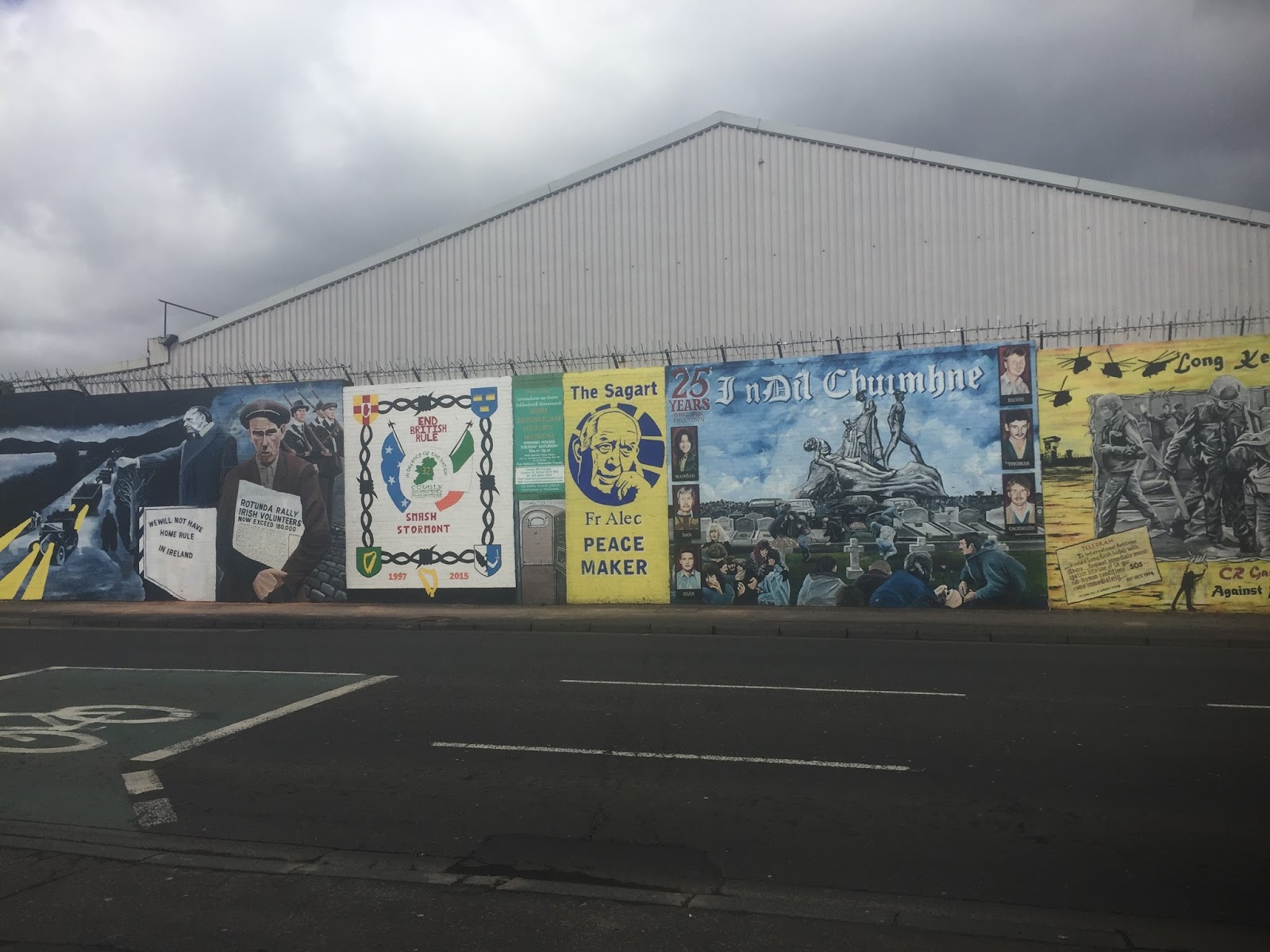
By far the most interesting thing we did in Belfast was a black cab tour with Michael, a taxi driver who had driven his cab as an illicit Catholic bus during the Troubles, after the barricading of Catholic neighborhoods meant Belfast municipal buses were restricted to Protestant areas. He took us around the Peace Line, a barrier that to this day separates neighborhoods by religion. Michael was full of historical tidbits and personal anecdotes, weaving a picture of guerilla conflict as we toured the protest murals and remembrance gardens which keep the memory of the recent conflict alive.

A section of the peace walls, slated to be taken down by 2023, although that may be an overly aspirational promise.
Murals in the Catholic Lower Falls neighborhood that recall history and grapple with current events.
Pierre and I were both surprised-- and chagrined at our ignorance-- to see how present the conflict feels. To the two of us, who knew relatively little about the situation and (in my case at least) were too young at the time of the Good Friday Agreement to be reading newspapers regularly, the Troubles were a thing of the past. I vaguely remembered learning at some point that there had been a wall, but I assumed (if I thought about it at all) that it had come down, like its counterpart in Berlin. In fact, it remains a thorny problem, as territoriality and community segregation are far from a thing of the past. Twenty years, it seems, has not been enough to assuage all grievances, or to restore trust lost over the course of a protracted and violent struggle.

But Belfast was not all somber reflection and activist public art.  We spent a lovely afternoon drinking Guinness at The Crown Liquor Saloon, a Victorian-era gin palace complete with stained glass, tile murals, gas lamps, and private wooden booths with elaborately carved doors. It was a suggestion from a Belfast friend, and an excellent one at that.


That night we went to hear an Irish folk rock band play in a pub. Pierre hit it off with a wobblingly drunk Irishman, who advised him not to marry me ("I don't trust her, she's too sober") then bought Pierre a beer and launched into an earnest, slurred conversation. In the interim I chatted with his friend, who told me at length about the Irish sports of hurling and Gaelic football, which, full disclosure, I didn't know existed. The band was great, the music was fast and full of fiddles, and Pierre and I were happy to make friends.

Next time: the Antrim Coast and Giant's Causeway!

Sunday, April 3, 2016

Dublin and Easter Rising

Ladies and gentlemen, I dust off the old travel blog and give you: the first of a couple or three posts about Pierre and my recent trip to Ireland over the Easter holidays. There will be a lot of pictures, because Ireland is a beautiful and highly photogenic place, and hopefully some worthwhile text.

In advance of flying into Dublin a week ago today, I had carefully planned my route from the bus stop where I would be dropped to our AirBnB and back out to the General Post Office, where the ceremony marking the 100 year commemoration of the Easter Rising would be taking place. But the best-laid plans of mice and men gang aft aglee, and mine agleed when a policeman boarded the 41 bus and announced last stop, as the center of Dublin was closed off for the Easter Rising parade.

Paddy, as I imagined the policeman to be named-- he sounded, by virtue of being Irish, like every cop in a film noir ever set in Chicago or New York, who are invariably named Paddy-- pointed me in the right direction. Before too long I started seeing roads lined with crowd-control barricades, which I followed to the main axe of the parade, O'Connell Street. Still unsure of exactly where things were in relation to each other, I decided to post up several hours in advance while the crowd was still sparse, rather than lugging my stuff around on a fruitless quest for the AirBnB.

With the advantage of ample time and a good viewpoint, I fell to chatting with a cluster of Dubliner women of a certain age, some accompanied by their young grandchildren. They had been children or young women when the 50-year commemoration took place, offset by a large protest from the Rev Ian Paisley and his hardline loyalists. The women traded fond memories of the parades of their youths, once an annual occurance, although subsequently suspended during the Troubles.

Start em young! Republicans from the cradle!

The women only spoke passingly of this period, and I did not ask them to elaborate, but it came up nonverbally later on. As giant screens along the parade route projected the Irish prime minister, the Taoiseach, presiding over a preliminary ceremony at Dublin Castle, two photographers appeared on the parapet of a building behind us. While the women continued talking and joking ("I hear the Air Force will be doing a flyover." "Oh aye? All four of our planes?" "Come now, Ireland has at least seven!"), I noticed their eyes swing sharply to the figures outlined against the roof. One, watching me follow her gaze, smiled and drily commented, "It's a good thing they have those cameras, or I might have thought them assassins."

There was, in fact, a flyover. It would seem Ireland has more than four planes, but possibly less than seven.
Finally the festivities commenced. Flickering onto the JumboTron screens, the scene playing out in front of the GPO took on life dozens of times every 50 meters down O'Connell Street. A general read Patrick Pearse's proclamation of the Irish Republic as the Taoiseach laid a wreath. As the flag was lowered to half-mast, the Taoiseach took the podium; I was gratified to hear him highlight the role of women in the Easter Rising, a role until now overshadowed by the names of famous male rebels.


And then began the biggest military parade in the history of the state. Tanks rumbled through the streets of Dublin, followed by armored personnel carriers, and what may have been anti-aircraft missile launchers, although I am wildly out of my depth when it comes to military paraphanialia. Troop upon troop of soldiers marching in lockstep paraded past the GPO in an outpouring of nationalism and republican pride. Brass bands played the national anthem, and then-- no joke-- "Danny Boy", and my gaggle of women sang along, shrilling through the high notes.


I finally left and found my way to the AirBnB, where a group of four Italian roommates and five or six of their Italian friends were preparing Easter brunch. They were gracious and voluble and invited me to join; and so I transitioned from a street packed with flag-waving, anthem-singing Irish to a room packed with laughing, gesturing, chattering Italians. The meal was delicious, and Pierre got in from the airport in the late afternoon, in time to join us for tiramisu.

Tomorrow: we hit the road for Belfast!

Thursday, November 26, 2015

Thanksgiving

This year marks the fourth Thanksgiving in a row that I’ve spent outside of the United States. While this has been a little sad—I miss Thanksgiving at my grandma’s house, with family and my aunt’s sweet potato casserole—I am grateful for having been able to celebrate every year. Sure, they were far from traditional holidays. They involved cooking over wood fires, slaughtering turkeys, and (unsuccessfully) scouring a Bosnian grocery store for anything that looked close to a Thanksgiving related grocery. But they were shared with friends (Will, here’s looking at you). They brought together communities I was lucky enough to live in and places I was passing through; I spent them in the homes of friends and strangers. In the best sense of the holiday, I shared the feast. For those experiences, I am thankful.

Things to be thankful for: Frozen turkeys at Sainsburys.
These last three years have also given me perspective. Thanksgiving is, in the broadest sense, a harvest festival—but it also serves an important role in our national American myth-making. We get to pretend our predecessors knew how to share, and not simply to take; we get to gloss over the uglier parts of our history and tell our children a tale of Pilgrims and Indians sitting down together to eat. We like to boast about being a nation of immigrants, and this is a celebration of “our”, whatever that means, initial immigration. We know history didn’t really happen that way—but this roots us in what we like to think of as the best parts of American culture: hard work, generosity, opportunity, family.

This Thanksgiving, let’s think long and hard about those values we claim as somehow uniquely ours (putting aside the observation that pretty much everyone in the world values their family). Every time I tune into the American news cycle, I am saddened. Presidential candidates spew out policy proposals that go beyond xenophobia and bigotry into the realm of neo-fascism. Suggestions that range from closing our borders with weaponized drones, to merging state and federal authorities into a centralized immigration police state, to (horrifyingly) creating a register of American Muslims, are taken seriously; are debated by pundits and analysts; are allowed validity through media and public attention. State governors make noise about refusing Syrian refugees fleeing genocide, overlooking the inconvenient fact that they don’t legally have that ability. My man Bernie is, so far, the only presidential candidate to put out a humane and rational immigration policy that would allow immigrants access to justice, to economic opportunity, and to citizenship—surely this is what we mean, when we claim to be a nation of immigrants? And yet he is branded a dirty socialist, a dangerous radical, for ideas that, 30 years ago, would have been mainstream. If you don’t believe me, look up Reagan on immigration and refugee policy. Have we really fallen this far?

This Thanksgiving, enjoy being around the table with whatever company of family or friends or strangers you find yourself amongst. Enjoy the food (oh, the food!), the subsequent turkey coma, and the football. But take a minute between shoveling stuffing onto your plate and drowning your potatoes in gravy to do a little naval-gazing. If we believe ourselves to have a national identity and to have inherited a culture worth celebrating, then we need to pay very close attention to what that identity means and exactly what those values should be encouraging us to do. We are being stoked into a frenzy by fear-mongerers and nativists—but we’re better than that. And right now, we’re facing an opportunity: to move together towards a more just and enlightened society; to open our arms to immigrant workers and war refugees alike, and to turn our backs on discrimination; and to build a path to citizenship that will lead to greater economic growth, greater—not less—security.

And for that, I am thankful. 

Thursday, September 10, 2015

Chartres

I've been in France for a week and a half. This past weekend Pierre and I spent three of those days with his family at the Moulin de Spoir, a farm and old mill on the river Eure outside Chartres. The weekend was wonderful.  Pierre’s parents were very sweet to me, his sisters and their families were great, and we threw a barbeque on Sunday for an assortment of friends, neighbors, and family. Pierre and his mother are both accomplished cooks, so there was no shortage of delicious food; the only challenge was saying no to a cheese course before dessert. There was fly-fishing; there were walks in the woods; there was excellent wine; there was a 10-km Sunday morning run through the countryside with Pierre’s sisters, Mme Decker on a bike behind us.
A river does run through it; that river is the Eure, and it is the Moulin de Spoir.

Pierre's brother-in-law and nephews give Kinder, a tubby Shetland pony, his biannual exercise.
Friday night after dinner Pierre and I headed into Chartres, to his best friend Tof’s house. Cast around in your mind for A Frenchman, and you’ll probably conjure up someone that looks like Tof: lean, dark-haired, chin encased in something perpetually between a shadow and a beard, rolling papers always close to hand. A mechanic and a perpetual tinkerer, Tof’s house is full of furniture he salvaged and modified. He’s direct, incisive, and encyclopedically knowledgeable about French cars.

After a drink, we left to see Chartres en Lumiere, the city’s annual summer-long light display. Upon discussion, it was decided that we would take the Dyane. This turned out to be a classic car I had heard about—around Pierre one might call the car, one of Tof’s pet projects, legendary—but not yet seen, the Citroen Dyane 6. A bright orange convertible from the mid-seventies, the Dyane is somewhere between an antique and a jalopy—“A great car,” Tof explained fondly, “although with this many people the ignition might not start right away.”

This turned out to be something of an understatement. With the Dyane geared in neutral and Tof at the helm, Pierre and I pushed the car the length of Tof’s street, breaking into a jog as Tof yelled back at us through the open driver’s side door, one flipflopped foot dangling. His scarf, an orange that (intentionally or not) perfectly matched the Dyane, flapped out along the side of the car as we painfully picked up speed. The engine finally sputtered into life, and Pierre and I leapt in, panting.

“And here I was regretting not having worked out today,” I gasped.

“You see? A multi-function vehicle,” Tof responded smugly.

“Just make sure you park on a hill,” Pierre muttered darkly from the back seat.

We pulled the hood back, letting in a rush of autumn air, and made our way towards the cathedral. Tof and Pierre pointed out monuments and the apartments of people I had met along the way.

Once we found a declining slope to nestle the Dyane’s nose down, we set out on a tour by foot. Our meanderings led us past bridges, monuments, and historic buildings that served as backdrops for light projections. I imagine it could only be maddening for those whose windows face a projector—and as Pierre remarked, the energy use must be staggering—but the result was lovely.  The cathedral, already a breathtaking structure, was the most stunning stop. Using traces of pigment that have been found on interior stonework during restoration efforts as a guide, the light designers had created a speculative suggestion of what the cathedral could have looked like when first built and painted; the paint is thought to have flaked off after a few generations, so no one really knows, but the result was magnificent.


The rest of the weekend went on rollers, as the French would have it, which is to say: went smoothly. Sunday afternoon Pierre hosted a cookout and petanque at the Moulin de Vilaine, a 14th century stone water mill, which was dismantled in large part by the French during the Second World War to keep the invading Germans from occupying it.  The millstones are no longer in place, but some of the structure still stands, and it is a perfect place to build a fire, throw a lawn party, or go fishing, all of which happened Sunday.

The Moulin de Vilaine


The afternoon wound down with a closely battled game of petanque. Mme Decker proved to be a formidable opponent. She studied the terrain, moved with decision, and unerringly nestled her metal boule gently against the cochonnet, or piglet, the small wooden ball that serves as a goal. Roger, a master gardener and retiree with a set of personally engraved boules, held the score steady for my team; his signature move was a sort of cannon blast that rarely failed to clear the earth around the cochonnet of enemy boules. Brute force won out over delicate sportsmanship, and our team took the win.

Roger, me, Pascal, and Laure: clearly look like winners to me.
We left Monday after lunch, the necessities of the working world luring us back to Bordeaux. Up next: I will maybe get the inspiration to write something about Bordeaux! In the meantime, I'm pretty sure a cafe in a afternoon-lit square in front of some kind of stone monument is calling me. My life is full of hard decisions.

Monday, August 31, 2015

A Photo A Day

I give you my last five days and an introduction to my neighborhood in a photo a day:


Wednesday 26 August: Victoria Park. A short walk (or shorter run) from my flat, Victoria Park is one of the largest green spaces in the East End. Alternately known as the People's Park, it was built in 1845 to provide the Victorian working classes with their own parkland. It is a beautiful space, with manicured lawns and gardens woven through with running and walking paths.


Thursday 27 August: Regent's Canal. I don't know much of historic note about the canal, but the towpath is busy with pedestrians, runners, and cyclists, and it is a lovely place for an evening stroll.


Friday 28 August: Brick Lane. Running through Bethnal Green to Whitechapel High Street, Brick Lane is the center of my new neighborhood. It reflects in microcosm the successive waves of demographic change in the East End. The name hails from its past as a district of manufacturing, close to the wharves on the Thames. Jack the Ripper did his ripping in and around Brick Lane, and the narrow streets and architecture reflect its industrial roots. 

The 19th century saw increasing Ashkenazi Jewish immigration from Eastern Europe; this period survives in the most popular bagel place in town, the 24-hour Beigel Bake. The bagels come laden with salt beef and gherkins (which are apparently not to be called pickles) and dripping with mustard. As a former New Yorker, I will say the bagels themselves are nothing to write home about-- they're sadly not water boiled, an essential component in getting the right chewy texture-- but let me not quibble with an institution. 

Brick Lane in the 20th century became home to London's growing Bengali and Bangladeshi communities, some of the largest current demographic groups in Whitechapel. Brick Lane reflects this today, with street signs in Bengali, innumerable curry shops, and several mosques. The area feels very Southeast Asian, and very Muslim; some of my neighbors, and many in the crowds in Brick Lane, wear djellebas and hijabs.

The final demographic group, the 21st century's contribution to Bethnal Green, consists of people like me: young and often white students, artists, and gentrifiers, drawn by cheaper rent, multiculturalism, and an increasingly trendy art and bar scene. Brick Lane has not quite reached the level of Shoreditch, a hotbed of hipsters one neighborhood further west, but I speculate that it's only a matter of time before current residents get priced out.


Saturday 29 August: ramen. Saturday I met up with a friend from NYU, Megan, who is in London for the next month. We did touristy things (London Bridge, Big Ben and the Houses of Parliament, St. James Park, etc). But you don't need pictures of those things-- you've seen them all already, in every movie ever made about England-- and in the interest of providing at least one picture with people in it, I give you our dinner, at a ramen place called Bone Daddies. It was delicious.


Sunday 30 August: Spitalfields City Farm. I guess cramming three pictures into one is technically cheating, but I wanted to show them all, because this was the most exciting place I've been since getting to London. An urban farm and community garden in the nearby neighborhood of Spitalfields (pronounced, unfortunately, Spittlefields), the farm is a lively place. The many concurrent projects include educational and family programs (the farm was crawling with toddlers at a birthday party when I visited); an acre and a half of garden space under cultivation; a community garden specifically for Bangladeshi women to raise culturally appropriate crops; a farmyard bustling with goats, sheep, chickens, pigs, donkeys, and a Shetland pony; apiculture; compost production; wool dying and yarn spinning; and a small cafe featuring seasonal vegetables and cheeses. It's an impressive operation. I'm hoping to start volunteering in the garden, as a way to meet people and to keep my hands in the dirt. I have the feeling that this could be a great place to get plugged in to.

Which leads us to today. It's August Bank Holiday, an annual long weekend, and there's a Caribbean festival and parade on in Notting Hill. It's been raining all morning, but if it clears up a little this afternoon I'll head over. Tomorrow evening I fly to France to spend three weeks in Bordeaux with Pierre; upon my return, school will start, and life will get real.

When it does, I'll keep you posted.

Wednesday, August 26, 2015

In Which I Learn I Don't Speak English English

I almost didn’t leave for London yesterday.

Monday morning before my planned Tuesday afternoon departure for England and grad school, I had still not received my passport back from the UK consulate with my student visa.  As if that were not enough, over the weekend I had managed to come down with a case of bronchitis. Whiffs of panic could be scented in the air in the Skove household. But things came together, as they do; my passport arrived, with all my papers in working order. After a lovely going-away gathering with my farm coworkers, Monday night found me clocking in 11:00 pm at a 24-hour CVS, washing down antibiotics with codeine.  Tuesday my parents gave me a lift to Dulles to see me off, and before I knew it I was on a plane.

It was then that I had a rude realization: British English and the English I know do not necessarily share vocabulary.

Let me digress for a moment to explain that when you have 3-foot-long thighbones, as I do, economy seats are a real pain. I don’t mean this in some metaphysical way, like the way all your friends singing that one song from Frozen is a real pain; I mean the tiny space between seats causes actual physical discomfort.  So you’ll understand that when the time came to choose a seat online, and I saw an aisle seat with extra legroom at no additional fee, I thought my stars had aligned for once. I noticed small print explaining that this seat adjoined “cots”, and briefly registered this as odd—I’ve never seen cots on a plane, I thought, imagining metal foldout beds, like summer camp or M.A.S.H.—but mostly disregarded it, because hey, legroom.

As it turns out, “cot” is British (or Bringlish, a term I just invented now to describe British English, because they don’t own the whole language, thank you) for baby bassinet. This is, I anticipate, not the last time that I will unintentionally hoodwink myself ("Wait, your car got booted?! Were you not supposed to park here? Why are you gesturing to the trunk? That seems irrelevant.")

Let it be stated for the record that those terms are NOT synonymous, whatever British Airways might think. A cot is a cot. A bassinet is entirely different, chiefly in that babies occupy it, a feature that was inadequately advertised. “THIS ROW EXCLUSIVELY FOR THOSE WITH TINY WEAK EARDRUMS AND HEALTHY LUNGS”, the website should have said, in 32-point bolded font.

My linguistic indignation was useless, however; I was sharing a row with two infants and a toddler, and I couldn’t even complain about it, because I chose the seat. I did this, the traveller’s suicide, to myself. We taxied into takeoff, and as the pressure in the cabin increased, the babies, on cue, burst into a chorus of howls.  About the time they quieted down, the fasten-seatbelt sign went off, and the toddler turned on an iPad to resume watching—I kid you not—Frozen.

“Let it goooooooo, let it GOOOOOOOOOO,” Idina Menzel shrieked from two seats over, and I was overcome by a strong urge to beat my head slowly against the baby bassinet (excuse me, cot) in front of me.

It was shortly thereafter that my friend bronchitis made an appearance, and I burst into a fit of chesty coughs. The one doomed innocent in row 35, a nice German man with limited English seated to my left, turned slowly to look at me with an expression of mingled disapproval and despair.

“It could be worse,” I rasped cheerfully. “I could have forgotten my cough drops, then we’d be in real trouble.” I smiled, to indicate that this had been a joke, but he didn’t laugh. We’ll chalk it up to the English.

I started thinking about ways I could possibly be a worse seatmate: I could have athlete’s foot and yet insist on taking my shoes off. I could have brought a bag of spicy nacho cheese to slurp on as an in-flight snack. I could be a third baby, a nacho cheese-eating baby with stinky feet and bronchitis, who didn’t pack cough drops OR clean diapers. This last one made me laugh, which provoked another bout of coughing. I thought about trying to share this bizarre hypothetical with my beleaguered neighbor—“Want to hear about the worst baby in the world? You could have been sitting next to her!”—but in view of the resolute way he was staring straight at the televised flight map in front of him, presumably willing the plane to be in London already, I didn’t think he was in the mood for more of my jokes. I let him be and retreated behind a book.

And thus, inauspiciously, began my time in London.

This morning I got to my new flat in Whitechapel with a minimum of hassle, thanks to an exorbitantly expensive cab ride from Heathrow to the East End. If I never take a taxi again until the day I move out, I may be able to justify that blow to my carefully planned budget. London, as two months’ worth of Charles Dickens audiobooks led me to anticipate, is gray and drizzly. My flat is cute, with (hopefully) just enough room for four people, and a pocket-sized garden out back. My German flatmate, Tayfun, is proving to be as great as he seemed via email. I already have a new number; email me if you want it.

I’ve seen too little yet to give much more of a description than that, so we’ll leave it there—I’m here; I suspect I’m not dying of consumption, as my meaty coughs would seem to indicate; and despite not having slept one wink on the plane, I can’t wait to get out and wander around through the drizzle, exploring my new neighborhood.


So I’m going to do just that. Until next crime!