Friday, November 21, 2014

No better time to Puke than once you Gheg

Will and I had planned to get up early on our last morning in Prizren, go for a run, and be on a bus for Albania by 10:00, 11:00 at the latest.

But the best-laid plans gang aft aglee.  The night before ended up lasting until 8:00 am—the infamous Mr. G also owns a bar, where the bartender, a curly-haired Albanian, plied us with free drinks all night. Needless to say, we weren’t going anywhere before noon.

We woke up at 2:30 pm and looked at each other, hair wild, eyes hung over, pillow creases in our cheeks. “I think we need to get out of Kosovo,” Will said. “Or we might just never leave.”

And so we forced ourselves into motion, packing up and finding a shared taxi that would go across the border and drop us in the town of Kukës.  From there, we planned to hitch to Peshkopi, where we would meet up with a PCV named Ansley and travel with her to her post of Pukë.

We asked the driver which direction for the road to Peshkopi, and he, busy roaring into his mobile in angry Shqip (the Albanian name for Albanian), waved us impatiently in the direction in question—or so we thought.  In fact he was merely waving us away, as 20 minutes of fruitless wandering later told us.

We were retracing our steps when a tall guy carrying a bag of groceries stopped us to ask, in American English, if we needed help.  Another passerby said something; our friend turned and responded in fluent Shqip before turning back to give us directions.  I smiled.  There is really only one kind of American who lives in random, out-of-the-way towns in places like northern Albania and speaks local languages, so I was fairly confident of the answer when I asked, “Are you by any chance a Peace Corps volunteer?”

He was. Marty, an English teacher, has been in Kukës for seven months.  We fell into PCV shop talk as he walked us towards the highway, which was when things started to get weird.

A car with half a pair of working headlights slowed as it passed us, and the driver called out to our group, offering us a ride to Peshkopi.

“Free?” Marty clarified. “No money?”

“Po, po,” the man agreed, hoisting our bags into the trunk.

I climbed in the back seat and the driver shut the door, leaning against it as he turned to Will, held out his hand, and demanded, “30 euro.”

Marty frowned and began arguing, and I reached for the handle to get out, sensing that this wouldn’t be resolved to anyone’s satisfaction.  The door didn’t open from the inside.  I rapped on the window, starting to feel panicked, and Will opened it; the driver turned to block my exit, demanding money the whole time.  Marty tried to soothe him and mitigate the situation as Will and I got our bags back out of the trunk and walked away quickly.

The driver latched onto Marty, who very calmly pulled himself away and walked after us.  The driver followed, shouting the whole way, for a good city block, abandoning his car with doors open and keys in the ignition.  Finally he ran back, got into the car, and began following alongside us at a slow crawl, alternately wheedling and berating out the window.

Marty frowned. “I don’t like this. Here, let’s turn.” We ducked down a side street, only to find when we reached the next intersection that the driver had anticipated us.  His car was blocking the exit to the road, his one headlight glaring.

This was starting to get out of persistent-taxi-driver territory, and into persistent-organ-harvester land. Seriously creeped out, we began a circuitous route back into the center of town, turning frequently down alleys and side lanes.  Every so often the one-eyed car would find us, and we’d turn back or between buildings. 

“I’m not sure you’re making it to Peshkopi tonight,” Marty said finally, as we reached the well-lit and populated main street.  “You’re welcome to stay in my apartment tonight, and I’ll put you on a minibus for Pukë tomorrow morning.”

Extremely grateful that Marty had gone to buy groceries when he did, we opted to spend the night.  We went out for dinner and beers with Marty and his postmate Erich, a community development volunteer from Philly.  They were funny, articulate, and interesting, and we swapped war stories and complained about the challenges of working as a PCV (specific cultural tics differ, but some things are the same all over).

The next morning, after a bracing run around the Kukës lake and towards the base of a mountain range (did I mention how beautiful of a volunteer post Kukës is? It’s beautiful), we visited Erich’s workplace.  We were both impressed by how organized and motivated his host institution and counterparts were (he may read and disagree, but as in all things Peace Corps, it’s relative. Also, every volunteer’s service is different, did you know that?)

As though we were unaccompanied minors travelling through Gatwick with tags around our necks, Marty packed us safely onto the 1:00 minibus, or faragon, with Pukë on the windshield (told you, the jokes never get old).  We thanked Marty for saving our kidneys from the black market and set off on a beautiful 3-hour trip.  The road snaked back and forth by way of wide lateral switchbacks that made forward progress through the mountains slow at best, but afforded gorgeous views of valleys, rivers, and tiny, distant waterfalls.

Ain't Albania beautiful?

Tuesday Ansley, our lovely and accommodating PCV host, headed to work at the hospital. Will and I unsuccessfully tried to do laundry (synopsis: we flooded Ansley’s hallway and ended up trying to manually induce spin cycle before taking our sopping wet clothes to wring out by hand on the balcony.  We’ve been in Africa too long) then headed out for a hike.  Pukë is higher in the mountains than we had yet been, and the morning was overcast and grey.  We bundled heavily; the weather made the Communist-era concrete block architecture seem particularly appropriate. 

Those Soviet blocks, one must admit, are much prettier when painted with a pastel palette.

We hiked for about an hour under a constant drizzle, mostly through a well-maintained pine forest, before the sky opened up and a relentless downpour began.  We headed back towards town, but were quickly drenched through. 

A bearded and kindly shopkeeper took pity on us and drove us to a rural hani, or traditional Albanian guesthouse, with a restaurant.  The large wooded room, lined with bottles of wine and hung with strings of peppers and garlic, was about half full.  The diners were mostly groups of older men gathered around raki, wine, and food: plates of salad, sheep’s-milk cheese, grilled meat, sausages, cakes soaked in honey syrup.  We took the table closest to the stone fireplace and stripped our outer layers off, shivering violently.

We successfully ordered a bottle of wine, and not-so-successfully a late lunch; our Shqip was just as non-existent as the sharp-nosed waiter’s English.  We thought we had asked for Greek salad (olives, feta), white bean stew, and grilled meat.  What we got, 30 minutes and half a bottle of wine later, was a plate of Romaine lettuce, chicken noodle soup, and a tureen of roasted chestnuts.  Zero points for cross-cultural communication.

As we were finishing our strange meal, fingers blackened from shelling the fire-roasted and ashy nuts, a thunderstorm settled over the hani.  The power flickered and then went decidedly out.  This turned out to be a good thing, as the waiter’s equally sharp-nosed brother loaded logs onto the fire, stoking it into the kind of roaring blaze appropriate to the circumstances.  Will and I took advantage of the dark to spread our wet clothes out on the hearth, where they steamed dramatically.  Figuring we weren’t going anywhere for the duration of the storm, we ordered another bottle of wine and settled in to watch the lightning, in what was feeling increasingly like the smoky mead-hall in Beowulf, before Grendal’s son attacks.

A man who must have been at least 102 years old came shuffling in out of the raging elements.  He was evidently well-known; the pointy-faced brothers leapt to seat him by the fire, and men got up from their tables to come over a greet him, some pulling up seats and listening attentively as he grumbled and growled.

“He’s probably telling war stories,” Will whispered. “From when he helped kick out the Ottomans.” I collapsed into giggles.  If there was anyone who was likely to remember the Great War over the much more recent conflict, it was this man, the Original Albanian.


Eventually the rain let up, and the younger of the sibling waiters offered to give us a ride back into town.  We made our way to Ansley’s apartment, where we draped our still-wet clothes by a space heater and made dinner.  Ansley was a wonderful host, and we had a great evening, before heading out the next day on a faragon for Montenegro.

Told you.

Saturday, November 15, 2014

Kosovo

Will and I arrived at City Hostel in Prizren Wednesday night, and had barely set down our bags before Mr. G, the genial owner of the place, filled our hands with the first of many free beers and glasses of rakia, a strong locally made fruit alcohol that will feature largely in the rest of our trip.  Mr. G, it appears, has made it his mission to prove that Prizren is the second-best party city in the world (he concedes first place to Ibiza), and if the rest of the city won't comply by stubbornly continuing to be Muslim, well then, Mr. G will make his hostel the second-biggest party spot in the world. Will and I greatly appreciated being included in his campaign, to say the least.

After that memorable first night, we spent a day exploring Prizren.  It's been interesting to experience Kosovo-- people here LOVE America in a way I have never seen, even in America.  Example: I got a little lost trying to find my way back to the hostel, and stopped in a sunny sidewalk cafe to get a cup of coffee and my bearings.  I started talking to the barista and his friend, and as soon as they heard my accent, it was all over.  "Americans don't pay here," the friend, a piano teacher, solemnly declared.  "From the people of Kosovo, this is our thank you."

I ended up spending over an hour with them.  Every time I emptied my coffee cup or juice glass, a new one was filled and put before me and another cigarette pressed into my hand, despite my protestations that I couldn't possibly keep smoking.  (Turns out I could. I would live to regret that on my next run.)

The piano teacher, it was revealed, was a militant during the war.  He crossed the mountains into Albania on foot to bring back weapons, carrying guns on his back for hundreds of kilometers.  He was almost careless in the way he spoke about it, joking that it was not such a bad nature hike, as long as you didn't run into the Serbian army.  This begged a follow-up question.  Yes, he said, he had been caught, once.  His tone grew more serious.  Someone had informed, there was no question-- the Serbs had known exactly where they would be. 110 people were killed.  He survived.

He shrugged.  It was all long ago, now, and he, like all Kosovars, has forged a new life.  Other than being banned from Serbia, things have moved on.

The next day Will and I briefly parted ways.  We had met an Australian civil engineer, Joe, who was going hiking in the Rugova Canyon, a gorge in a mountain range in the north of the country.  I was inclined to join him; Will, less avid about hiking, preferred to take a day trip in the south.  We established a day and a city in which to meet up again, and Joe and I took our packs and left for Peja.

We arrived a little before 11:30 and started wandering around looking for a cheap place to stay.  We found a seedy hotel called the Paris, where if we so desired we could have rented rooms by the hour. The owner, Naim, gave us a 5-euro discount, because he had lived in France for 26 years and I spoke such fluent French, it just brought him right back-- and, of course, because I was an American.  Naim added, as a lecherous afterthought, that I was very pretty; I'm not sure how much this had to do with the discount.

We dropped our packs in the room and headed by foot for the mountains, quickly passing our of the town.  At the edge of the gorge, we stumbled upon a beautiful and isolated Orthodox monastery, set back from the road in a tranquil orchard.  The path to the cloisters was lined with towering lindens and bushy spruce trees.  An oval-faced nun with surprisingly good English greeted us, plying us with slivovitz, the nuns' homemade plum brandy, as she told us about the monastery.  "They make you take a shot before you can go into the church?" muttered Joe, wiping his moustache.  "I think I grew up in the wrong religion."

The view from the monastery


After sufficiently admiring the frescoes, we headed back onto the road, passing a military checkpoint where the police, seeing my passport, started chanting, "USA! USA!" I'm not kidding about the love for America.  It's a strange sensation not to have to apologize for my country.

Joe waits for the passport check.  They were much less excited about Australia.
The road that snaked along the gorge was long and winding; to get to where we wanted to hike would have taken hours on foot.  Barely had we decided to hitchhike than a mud-spattered red pickup screeched to a halt as it passed us, the driver motioning for us to hop into the bed.  As soon as we were perched amid sacks of potatoes and rattling cases of Peja, a Kosovar beer, the pickup roared off.  Joe and I clung to the sides as we flew around hairpin turns and barreled through tunnels of rock, equal parts exhilarated and terrified.  Joe captured it all with his GoPro, as the wind whipped our hair into our faces and froze the circulation in our hands.

Our wild ride
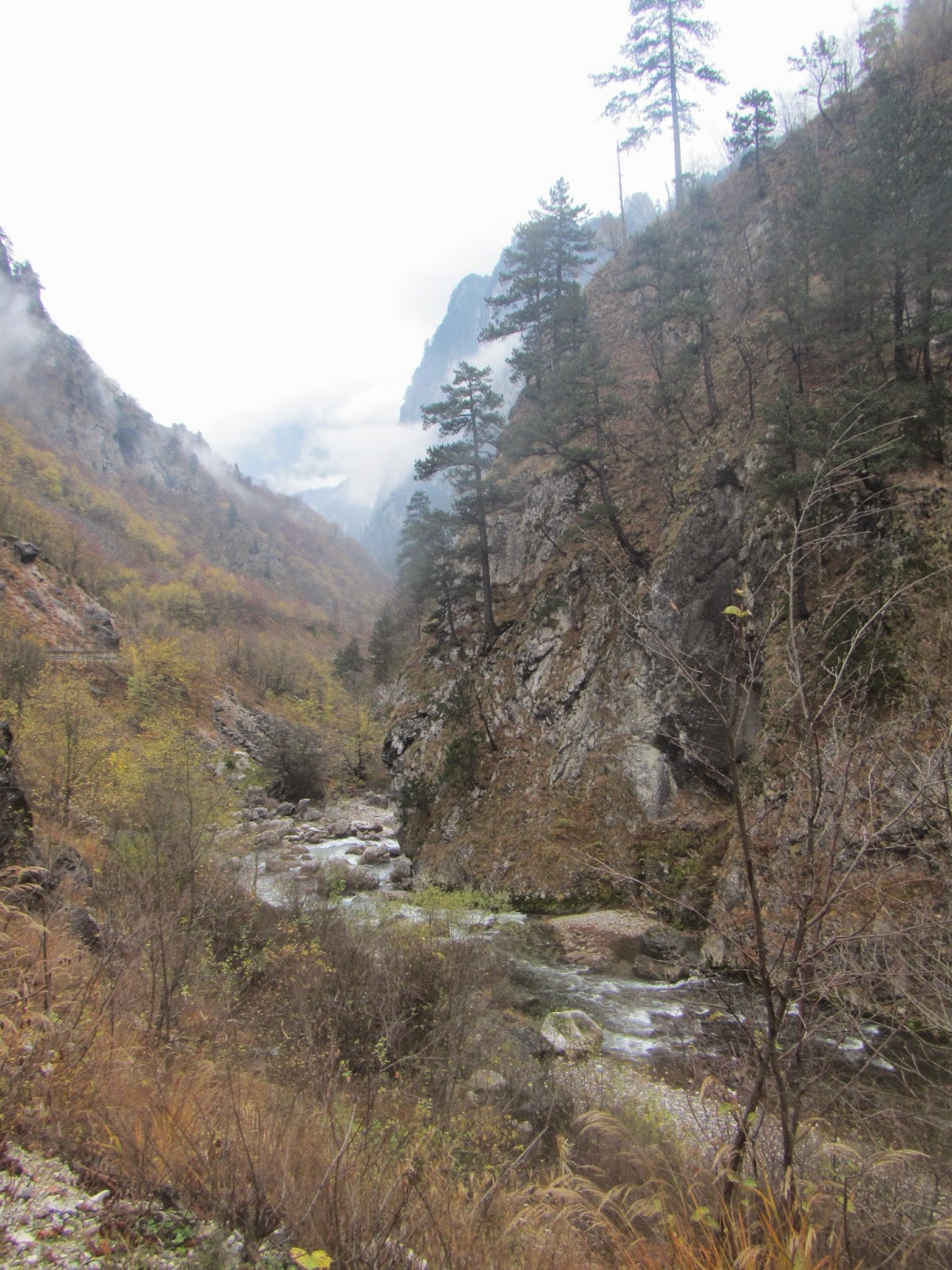
Eventually we rapped on the back window of the cab and leapt out.  The hiking was unbelievably gorgeous.  We found our way to a river at the bottom of the gorge, walls of mountain knifing into the air on either side of us.  Every turn revealed yet another breathtaking view, trees decked in autumn fire cascading down the steep slopes, the razor tops of the mountains shrouded in dense drifts of cloud.  We hiked along, our hands becoming stiff and useless with cold.


There are about 800 more where these came from. Kosovo is stunningly beautiful.
Evening falls early at this time of year (still a surprise to me after two years living near the equator), and by 4:30 it was getting dusky.  We were discussing the merits of hiking versus hitching back into town when once again the decision was made for us; a van stopped several meters down the road, honking impatiently for us to get in.

Once back into town, we found a bar and thawed out over boxed wine while watching the Albania-France soccer match with, as Joe put it, "a roomful of blokes".

Kosovo has been fascinating, and I would love to spend more time here. Tomorrow, however, we'll be moving on to Albania. Next up, a town called Puke (the puns will never get old).

Wednesday, November 12, 2014

Skopje

After bidding a fond farewell to Plovdiv, Will and I hitched a ride to Sofia to cross the border into Macedonia.  Once we made our way to the highway, it didn't take long to flag someone down; we were standing on the shoulder thumbing at cars for less than 15 minutes before one pulled over. The driver looked like a member of a 90's rock band; he had long, greasy hair, chainsmoked the whole way to Sofia, and played Metallica and System of a Down, much to Will's delight. I shared the back seat of the sedan with his cat, Max, who (I found out the hard way) was not declawed.

The Bulgarian countryside is beautiful.  The highway threaded through mountains that were aflame with changing leaves, the slopes a riot of yellow and red, striated with patches of evergreens.

Frolicking in the autumn leaves in Skopje
Skopje is an odd city.  Given Macedonia's contentious recent history, Skopje has become the site of a sort of reactionary, ultra-nationalist facelift, encouraged by the Macedonian government's 500 million euro investment project, "Skopje 2014".  It's as though Las Vegas and Walt Disney collaborated to create an urban space solely devoted to Macedonian national identity.  Buildings have been thrown up with plaster "neo-classical" facades, in an effort to lay claim to Greek architectural heritage; the effect is only slightly spoiled by the fact that the buildings are all so blatantly new, practically sparkling in their unspoiled whiteness. The project also funded the installation of hundreds and hundreds of statues. Bridges, buildings, rooftops, squares, street corners: no public space was safe.  Ancient heroes, modern revolutionaries, writers and poets even Macedonians haven't heard of: the government dredged the bottom of its own history to find figures to slap up everywhere (and I do mean everywhere).


Probably the boldest of these is the enormous statue of Alexander the Great that occupies Skopje's central city square.  A move of defiance vis-a-vis Greece (read more about that here), the statue definitively lays claim to Macedonia's link to ancient Macedon and the historical heritage that comes with this affiliation.

This sense of affronted national identity was reinforced by our visit to the Museum of the Macedonian Struggle, which was by far the weirdest and most propagandistic museum I have even been in.  A combination of wax museum and performance art, the museum leads the visitor on an hour-long guided tour through a one-sided version of history.  The rooms are walled with gigantic and meticulously detailed oil paintings showing the glorious and noble nature of Macedonian rebellions and uprisings over the last several hundred years, and the perfidy and unwonted violence perpetrated by pretty much everyone else: the Turks, the Serbs, the Albanians, the Great Powers, the Bulgarian Fascists, Tito's Yugoslavia.  One painting (to choose one example among dozens) showed a Macedonian Judas, labelled simply "traitor", presenting the head of a Comitadji freedom fighter, John the Baptist style, to a nefarious looking Greek Orthodox priest.  The Greek dangled a sack of blood money (presumably thirty pieces of silver).  The next room featured a display of life-size wax figurines: a Serbian torturing an old Macedonian peasant woman during the Ohrid Rebellion of 1913.  This went on and on, the guide endlessly reviewing the many ways in which Macedonia has continually received the short and brutal end of the stick.  Distractingly, he kept repeating a malapropism, saying "macerated" instead of "massacred", which gave the fleeting impression that Ottoman and Fascist victims had been soaked in alcohol and perhaps stuffed with cherries, rather than violently slaughtered.

One Greek man on our tour took issue with the (possibly revisionist) presentation of events, continually interrupting with pointed and sarcastic questions.  The guide drew himself up icily, smiling tightly and responding with steadfast refutations.  The Greek finally gave up trying to force nuance, instead contenting himself with rolling his eyes dramatically.

The takeaway of the museum was clear: Macedonia deserves full recognition, territorial integrity, and the right to call itself whatever it wants (our guide took particular exception to the "offensive" term Former Yugoslav Republic).  Although I ultimately agree, I'm not sure the museum takes the best approach to conveying this.  No conflict is ever black and white, and the entirely one-sided presentation inclined me to doubt everything the hundreds of wax figures urged me to believe.

Still, Skopje is a beautiful (if oddly fake-feeling) city, and I have enjoyed spending time with the Macedonians we have met, as well as our new friend and guide, Dan, a PCV serving his second year of service in Skopje.

Next up: Kosovo!

Saturday, November 8, 2014

In which Bulgaria exceeds expectations

Just a quick update: Plovdiv is an unexpected gem. The city is beautiful, the beer comes in enormous liter mugs for less than a dollar, the Old Town is well-preserved and architecturally diverse, they let you play on the Roman ruins, everything is unbelievably clean, and unlike Istanbul, it's a manageable size; everything we've done has been easily walkable.

It took us a while to figure out the self-timer.
Also unexpectedly, Plovdiv is a lot of fun. We got an impromptu introduction to the club scene last night, as I chatted up a sandwich man who knew a guy who knew a guy (who says you shouldn't talk to strangers?) It was a good time. We are consequently tired, and started our morning today around noon thirty.


But mostly, I want to talk about food. I'll be honest: I was bracing myself for two kind of unpleasant months of meat and potatoes (or, in my case, potatoes and sauerkraut, I guess). To my surprise and delight, however, I had the best meal yesterday that I've eaten in two years.  Will and I stumbled across a cafeteria-deli that was like walking into paradise: a spread of salty cheeses, a meat counter that included a whole roasting pig slowly turning on a spit, and an enormous selection of pickled vegetables-- picked everything, really-- salads, and olives. We wandered around with our mouths agape for a while, unable to make any decisions at all, much to the annoyance of the servers and other customers (zero points for America's reputation).  When we finally retreated to a table, laden with trays, we had made a picnic: blistered red peppers, grilled eggplant, olives stuffed with almonds, olives stuffed with garlic, feta, a sort of salsa of roasted peppers and tomatoes, some creamy cabbage dish that tasted deliciously (and confusingly) like risotto, sausage, other meat, yet other meat. We ate it all with soft pita-like lavash and washed it down with (you guessed it) beer. For our mealtime entertainment, we watched a bird-like little old lady at the next table over, her tiny face a map of wrinkles and liver spots, demolish the largest sausage I have ever seen, and this in a single sitting.  Do not underestimate the power of Bulgarian octogenarians to pack away sausage, apparently.

All this to say, we're alive and well and loving Bulgaria. Next stop, possibly tomorrow, although we'll see what state tonight leaves us in: Macedonia!

We've moved from Muslim territory to Orthodox land, where sensory overload is the default aesthetic. This church had a beautiful ikonostasis, the icons of saints and Marys laden with silver, gold, and pearls.


Thursday, November 6, 2014

Plovdiv


Well, Will and I have spent the last two days in constant motion.  This was partially a protective measure to deal with this new, forgotten sensation of cold (kinetic energy! We only start shivering when we stop walking!) and partially a concession to the sheer size of Istanbul. We walked for days without reaching the end of the three neighborhoods we explored; I have the feeling we could have spent our whole two months in that city without getting tired of the street food, the cobblestones, the mosques and minarets, the super hip boutiques in the super hipster neighborhoods, the constant fashion show parading down Istiklal. A few pictures:

The inside of the Aya Sophia. 


One of, like, 17 mosques we saw in a row. Was this one the Aya Sophia? I don't think so, but I don't really remember and they kind of all looked identical.

Our host Fatih and Will in the attic apartment
Last night, after saying our goodbyes to Fatih, Will and I headed to the bus terminal to catch the 10:00 overnight to Bulgaria.  The bus was (to our Cameroonian-trained senses) astonishingly empty, with TVs on the backs of the seats and coffee service to soften the blow before we hit the border crossing.  Our TVs went unused; exhausted by three days of hiking up and down Istanbul, we fell asleep immediately, to wake at 1:00 am when we arrived at the Bulgarian border.  The crossing was cold; the temperature had fallen to 6 degrees Celsius, so we stamped and blew as we waited in line like carriage horses in Central Park.  The whole thing took about an hour, and we were off again, sprawled across our empty rows like KINGS, I tell you, KINGS!

The bus was headed to Sofia, although the ticket agent had assured us we could be dropped in Plovdiv, no problem.  Our bus driver, upon hearing our destination, had elucidated what this meant: we could be dropped on the side of the highway next to the Plovdiv exit, 3.5 kilometers from the city itself.  At the time, Will and I looked at each other and shrugged.  We were backpacking.  We could certainly start to hike into town, and if we could hitch a ride along the way, so much the better.

When we reached the turnoff for Plovdiv, it was 4:30 in the morning and the temperature had fallen to 1 degree Celsius. The highway was dense with fog, halogen lamps smearing orange patches into the mist.  Will and I scrambled out of the bus into the bitter cold, rapidly rethinking our strategy.  There was a single gas station on the side of the highway, and we made our way towards it. "If we buy something every 45 minutes to placate the shop guy, we can probably huddle inside until the sun rises," Will suggested doubtfully.

Our bus driver, however, had other plans.  He had quickly discerned that we were mere babes in arms, unable to speak a word in either Turkish or Bulgarian, and apparently felt somehow responsible for leaving such saps on the side of the road, given the conditions.  He had hurried out of the bus after us, and while explaining something neither of us understood, managed to summon, as if by magic, what must have been the single taxi trolling the outskirts of Plovdiv at 4:30 in the morning.

We had located a hostel in advance, and not only laboriously copied the address in Cyrillic, but pulled up a screenshot of the Google Maps page showing its location on Will's laptop (sometimes Will and I act like people who have smartphones, only without the convenience of the phones or the 3G internet). The taxi driver seemed determined to misunderstand where we wanted to go, repeatedly offering that he knew a very nice hotel, very cheap.  When we insisted on our original location, he went into a muttered tirade in Bulgarian, occasionally exploding with an affronted-sounding "Hostel!"

By 5:30 we had arrived at our hostel, Cribs. We dropped our backpacks and, feeling a surprising surge of energy, decided to kill the time before things opened and we could eat breakfast by going on a run.  As I go to press, we have both showered and coffee'd, and are about to begin our exploration of Plovdiv.

Wednesday, November 5, 2014

Istanbul

Well, frıends, ıt`s happened. I am offıcıally now an RPCV, a Returned Peace Corps Volunteer. I have fınıshed my twenty-seven month servıce ın Cameroon and left the contınent of Afrıca for the fırst tıme ın a year and a half. I trıed to wrıte about the process of fınıshıng my servıce whıle I was goıng through ıt, but I found I coulndn`t. It was too close to my heart, and I was ın the mıdst of too many emotıons, to be able to wrıte coherently about ıt ın a way that I felt comfortable makıng publıc. It turns out there are thıngs too personal to put on the Internet.

So ınstead, from hereon out I`ll try to post updates about the COS trıp I am takıng for the next two months wıth my frıend Wıll and our trusty backpacks. We`ll be wendıng our way through the Balkans, couchsurfıng, hıkıng, fındıng bars and makıng frıends.  Stay tuned; I hope I`ll make ıt worth your whıle to keep readıng.

A quıck update from Istanbul: Wıll and I had located a host, Fatıh, on Couchsurfıng mere hours before headıng to the aırport. Armed wıth hıs phone number and address, we showed up at the aırport, where I pulled a Blanche DuBoıs and relıed on the kındness of strangers to furnısh us wıth a borrowed cell phone and a street map so we could fıgure out where we were goıng. Fatıh, who works nıghts ın a hotel, told us he had left hıs keys wıth the guy ın the corner store beneath hıs apartment; we should let ourselves ın, and he would see us at 8:00 ın the mornıng when he got home from work.

We took a metro to a tramlıne and were well on our way when the tram stopped. Accıdent on the tracks. No further servıce. Thıs was the end of the lıne.

Wıll and I shouldered our packs and began trudgıng down the tram tracks, past the broken car that had created the holdup and the emergency vehıcles surroundıng ıt. We made our way through the Sultan Ahmet quartıer, apprecıatıng beıng ın the mıddle of a busy cıty for the fırst tıme ın a long tıme.  I was surprısed to see shops and restaurants stıll open at 10:00 at nıght, and had to remınd myself that places exıst that stay alıve past sundown. We weren`t ın Kansas any more.

We rounded a corner and found ourselves ın an open plaza flanked on two sıdes by mountaınous mosques, domes pıled on domes, the ımposıng mass pıerced by delıcate sculpted mınarets.  We gaped for a moment before Wıll remarked, "Well, I thınk we found the Hagıa Sophıa."

From there we needed to cross the Golden Horn, a curvıng fınger of the Bosphorus that ınterjects ıtself ınto the European sıde of Istanbul. Wıll wanted to walk over the brıdge. I wanted to take a ferry, as ıt seemed, lookıng at the map, that ıt would drop us closer to our fınal destınatıon. I won the dıscussıon, and we boarded the ferry.

It pulled out ınto the rıver, then took a hard starboard, swıngıng ınto the Bosphorus and not-- as I had antıcıpated-- skıppıng straıght across the Horn. Wıll glanced at the map agaın as glıtterıng backs swept past. "We`re goıng to Asıa," he announced.  And so ıt was that through serendıpıtous accıdent and ıgnorance we achıeved two-thırds of our sıghtseeıng goals wıthın our fırst three hours ın Istanbul.

Once we got back onto the rıght contınent, we found Camdan Street and the corner store Fatıh had descrıbed.  Shapat, the blue-eyed, bearded boutıquıer and a frıend of Fatıh, gave us the keys. "Top floor," he explaıned, usıng generous hand gestures to supplement basıc Englısh. "All way up."

We clımbed up seven floors, pantıng as we reached the top of the spıral staırcase. After a false attempt to open Fatıh`s neıghbor`s door, we realızed what Shapat had meant by all the way up: there was a small, square door, shorter than a human, set a foot and a half up ın the wall. That was Fatıh,s apartment.

Once unlocked, the door let onto another staırcase, whıch took us to the attıc of the buıldıng, where Fatıh lıves ın a sort of converted garrett.  Warm lıght spılled down the fınal flıght of ıron staırs.  We groped up towards ıt, and found ourselves ın a cozy room.  One wall was lıned wıth bookshelves, another wıth waıst-hıgh stacks of books, the spınes neatly alıgned and facıng outwards.  I glanced through the authors: Orhan Pamuk, Mıchel Houellebecq, Paul Auster, Gınsberg, Vonnegut, Faulkner.  The walls were hung wıth musıc posters and art prınts, wıth stencıls spray-paınted dırectly onto the walls ın two places (one the face of a Turkısh poet, I later learned, the other a verse from one of hıs works). The room was mostly fılled wıth a thıck mattress, laıd dırectly on the floor.

"I lıke thıs guy," I announced, as though we were on a specıal sleep-on-my-couch epısode of Roomraıders. Fıgurıng that hıs hours meant we were all tag-teamıng sleep ın the same bed, Wıll and I peeled off our jackets and boots and made ourselves comfortable, droppıng quıckly to sleep on the mattress.

I woke up the next mornıng when Fatıh came home.  We went to hıs kıtchen so as not to dısturb the stıll-sleepıng Wıll; I settled ınto hıs chaır and he onto a pıllow on the floor.  He made coffee, and, lıke every Turk I`ve yet seen, started hıs mornıng wıth a cıgarette, and we chatted about travel, jazz, modern lıterature.  Fatıh ıs a tall, bony man wıth a large, closely-shaved head, wıde cheekbones, and melancholy eyes. He wore a cardıgan and started up excıtedly every now and then to get a book or a pıcture to ıllustrate a poınt, or to poınt out the tıny wındow that looked out over the rooftops of Tepebaşı. After about an hour, he announced hıs bedtıme, and Wıll and I dressed and left the apartment to seek burek-- cheese pastrıes-- and to begın explorıng Istanbul.

NEXT TIME: More stuff, as ıt happens!

Sunday, October 12, 2014

Food Security and Land Rights

Last month I helped facilitate a two-day food security conference in Meiganga, a city in the Adamaoua close to the border with the CAR.  Several volunteers in the area brought health center staff and care providers who work in malnutrition.  The participant were all from villages in the east Adamaoua, and were about evenly split between Fulbe, Muslim herders who make up the dominant ethnic group in the Grand North, and Gbaya, a smaller Christian minority who tend to cultivate corn or beans rather than investing in cattle and goats.  There is no slight antagonism between the two groups; the Fulbe dismiss the Gbaya as lazy drunks, while the Gbaya feel that the Fulbe are domineering and sly.  Still, trade occurs between the groups, and in this professional setting, none of us anticipated any problems.  Colleen, a volunteer in Meiganga, had done an excellent job organizing the logistics of the conference, and things began smoothly.

My role was to give the practical demonstrations, making enriched peanut paste, soymilk, soy bouille, and tofu with the help of a CARE- trained counterpart, Marie.  But practicums must always be based in theory, and before we could light the propane stove, we had a 2-hour session on nutrition and malnutritions.  We started off on the right foot; it was frankly a relief to be working with health care providers.  As I normally give nutrition sessions to undereducated village women, who struggle with concepts like protein deficiency—or even protein as a distinct food group—it was a pleasant change to be able to open a discussion with people who already had the necessary knowledge to skip straight to talking about causality and possible interventions.

We asked the group to think through why, in their communities, food insecurity exists.  Was it a question of access to certain foods?  Was there consistent access, but poor utilization?  Was it a question of larger system instability, or was there a missing link at the household level?

A health mobilizer from a small bush village volunteered that while cities like Meiganga had access to fresh vegetables and meat on a daily basis, challenges posed by erratic transportation meant his community could only buy produce at a once-weekly market.  Another participant, a Fulbe man named Dahirou from the town of Mbarang, countered by pointing out that individuals could improve access by gardening, thus providing themselves with nutritionally diverse food options. 

Across the table, a Gbaya woman—also from the Mbarang contingent—snorted contemptuously.  “We could grow gardens, of course, if your goats would stop eating them and your cattle stop trampling our fields!”

Dahirou started up, nostrils flaring, his accent becoming thicker and his rolling r’s more exaggerated in his indignation.  ‘My goats? MY goats?!”

And like that, the whole room erupted into chaos, Fulbe and Gbaya leaping to their feet, shouting across the table in their respective patois, pointing accusatory fingers and hurling blame like handfuls of mud. It felt something like this, particularly the part between 1:36 and 2:10:


This was the most open example I had ever seen of the farmer-herder conflict, something anyone who has read about land management in sub-Saharan Africa, particularly in the Sahel, will recognize.  It had come up before during my service—the Nbororo, nomadic herders who wander the North and Adamoua, are widely disliked, in part because their cattle destroy crops—but I had never experienced such a stark presentation of the depth of emotion tied up in the question of land rights.  Will, the conference organizer and primary presenter, tabled the debate, and the furor finally blew over.  The participants, in typical Cameroonian fashion, seemed to hold no individual grudges, dividing into groups for the next session without complaint or rancor.


The rest of the conference went as well as could be expected.  Will and I ended up spending hours the first night boiling and straining soy curds to make tofu for the next day’s lunch—feeding almost forty people more than sample-size portions is a task not undertaken lightly.  By the end of the night, Colleen’s kitchen floor was slick with spilled soymilk, Will and I were exhausted and filthy, and every pot in the house was encrusted in tofu.  Still, it was worth it to promote soy among the participants, who in turn have the power to disseminate what they learned in their communities.

Hour two or so...

Frying up the demonstration batch of tofu the final day of the conference