Saturday, February 22, 2014

All Creatures Great and Small

An unexpectedly good follow-up to my last post:

This past week I visited the Anglophone Northwest region of Cameroon, winding an intentionally tortuous route back up to the Adamaoua and my new post.  I met up with a friend from training, Michael, and traveled with him from the regional capital of Bamenda through the verdant mountains to his post of Mbengwi.

On the way, he mentioned that his cat, Dee, was very pregnant. "We might come home to a pile of kittens," he warned.

Instead, we walked into his house to find Dee prone on the couch in a puddle of kitty vaginal secretions. Michael bent over her, then straightened up quickly.  Something was very wrong. The tiny tail and one leg of a clearly dead kitten had been delivered, but the rest of the body remained lodged in her birth canal.  Dee was no longer having contractions-- in fact, she was no longer moving-- and from the almost-rotten stench, it seemed the stillborn kitten might have been there for hours.

Being a health volunteer in Cameroon, one inevitably encounters medical emergencies in less than ideal conditions, and learns to deal with them as efficiently as possible.  Within minutes, Michael and I had washed and gloved up and constructed an impromptu veterinary operating theater with a deep plastic tub, an old pair of pagne pants, and a Maglite weapon-grade flashlight.  As I balanced the light and held Dee down, Michael gently worked the body out of her birth canal, easing the second back leg around before pulling the upper body out in a gush of foul-smelling fluid.  We phoned Julie, a volunteer veterinarian, who recommended the correct dosage of antibiotics to combat possible septicemia; Michael fetched a syringe and gave Dee a subcutaneous injection of saline solution to ensure that she rehydrated as quickly as possible.  As I gently stroked the camel's hump of saline wobbling over Dee's shoulderblades, I felt sad for her trauma, but proud of us.  We had handled the situation.

There was, however, a mystery that remained: what had happened to the rest of the litter?  Michael was sure he had felt at least three kittens kicking in Dee's belly, but searching in and around the house turned up nothing.  We concluded that they must have also been stillborn, and that Dee had eaten them (this being, it seems, something that cats do).

The next day we spent with Caitlin and Emily, the other volunteers in the Mbengwi cluster.  We hiked up a mountain to get a view of the town spread out below us, buildings interspersed with lush palm and eucalyptus groves.  It was a lovely spot, and we spread out a picnic of fresh bread that Michael had baked the night before, buttery avocados, and bananas.  Hiking back down to a bar, we met up with some friends and colleagues of the three volunteers, and drank and danced into the evening.

Once back at the house, Michael and Emily found their way to bed, but Caitlin and I stayed up talking.  Suddenly we heard a clattering in the kitchen, followed by a chorus of piercing mews.  We turned to see Dee trotting into the salon, something gray and wriggling in her mouth.  Mouse! I thought at first, then, horrified, Dead kitten!

It was neither; Dee, it seemed, had successfully birthed at least one of the other kittens, and hidden it away somewhere in the brush behind Michael's house.  Once sufficiently recovered from her exhaustion, she had apparently remembered her kitten and fetched it again.

The kitten, eyes still shut tight, was mewling frantically, but seemed unable to nurse. We tried to guide it several times to one of Dee's six nipples, but each time it crawled blindly over her body, a little ball of writhing need.  Dee was no help, purring contentedly but seeming not to know what to do with her own offspring.

Caitlin and I, again thrown into the role of impromptu vets, mixed powdered milk and made a makeshift nipple out of a plastic bag.  We drippily fed the kitten until it quieted down, then tried again to guide it to Dee.  This time it found a nipple and clamped on, kneading Dee's stomach with its tiny pin-prick claws.

And once again, I was proud of us.

Is it bad that I want to name this guy Adolf?  Maybe we can compromise on Charlie.

Sunday, February 9, 2014

When Childhood Dreams Come True

Growing up, I wanted badly to be a large animal vet.  This was entirely inspired by James Herriot books and a vaguely romantic idea about stomping around barnyards in Wellington boots and birthing cows— which could probably only seem romantic to someone who, like suburban pre-adolescent me, had never actually seen a cow up close. 

In time this was discarded, to be replaced by subsequent desires to be a novelist, a Broadway star, a singing waitress (let it never be said that I don’t adjust my expectations realistically), an Egyptologist, a socialist historian, a Peace Corps volunteer (arguably the ultimate way to put off knowing what you’re doing with your life) and now, in what will hopefully be my last pivot, an environmental conservationist.  (Or a writer for National Geographic.)

I bring this up because I finally got the chance to live the dream, so to speak, when my bush dog, Scipio, passed the six-month vaccination mark and simultaneously went into heat for the first time.  I had been half-heartedly planning to take her in to the nearest vet in Guider for her rabies shot for several weeks, but the thought of trying to transport an almost-fully grown dog on a moto for an hour was enough to encourage my procrastination.  That changed when she started getting lethargic and drippy, emanating a musky smell so strong even I noticed it—as did every male stray in Mandama, to judge from the rustling and whining around the back door each night.  After three straight nights of being woken around midnight to Scipio howling in the salon, and the successive check of windows and doors to assuage my paralyzing dread of Boko Haram, I decided it was time.  Skip and I both needed for her to be fixed.

So into Guider we went, Skip squashed onto my lap on the moto, head resting on the driver’s shoulder—a more intimate but equally windy version of the head-out-the-window.  I took her to the Délégation d’Elevage, the Ministry of Animal Husbandry, an officious name for a peripatetic large-animal vet, or Guider’s very own James Herriot.  The walls were plastered with posters advertising various bovine prophylaxes, vaccinations, and vitamin supplements; all featured glossy photos of glowering cattle and smiling herders.  Beside the office door, a notice warned against avian flu.  “THE SALE OF DEAD BIRDS IS HIGHLY ILLEGAL”, it blustered unnecessarily (really, who would buy an already dead but not cooked chicken in 105-degree heat?  This isn’t the Safeway freezer case we’re talking about).

The vet, a kindly man with small glasses and an unexpectedly professional air, had to rummage through his cabinet to come up with the rabies vaccine.  He didn’t get many dogs, he explained—sometimes cats, but mostly his clients were goats and bulls.  I asked about getting Scipio fixed, and his face fell.  Ah, yes—well, there was no surgical theatre on the premises, and that was a fairly intrusive procedure.  If this were a male dog, no problem, he could do it right here in his office (this accompanied by a snip-snip motion of the fingers), but no, he could not help Scipio.  Was there such a thing as canine birth control? I asked.  Some shot, or pill?  At this he laughed heartily.  “If you need family planning,” he chuckled, “go to the hospital.”

And so I did.  I tied Skip to a tree outside, hoping that none of the moto drivers lounging around waiting for clients would harass her, and walked up to the font desk in the triage area.  “I’d like to buy Depro,” I announced, knowing from my own health center that the three-month contraceptive shot would be widely available.  The nurse immediately shushed me, leaning in to whisper, “If you need family planning counseling, go down the hall to the second office on the right and ask for Dr. Abdoulaye.”  It hadn’t occurred to me that I would be the assumed recipient, and while I was glad to see the staff treating a topic so taboo in Muslim culture with sensitivity, I felt a need to correct her misapprehension.  “It’s not for me,” I told her, realizing as I did so that this was about as plausible as “I got this black eye walking into a door”.  She nodded, and smiled knowingly.  “Right.  For a friend?”  Sensing that this might not be the time to introduce my menstruating dog into the conversation, I agreed, and went in search of Dr. Abdoulaye.

The doctor, head of family planning services in Guider, ushered me into his office and closed the door tactfully behind me.  Feeling a little embarrassed by the thoughtful yet unwarranted level of discretion being shown, I introduced myself, then launched in: “I want Depro, but not for me, I already have an IUD.  C’est pour mon chien,” my dog.  Dr. Abdoulaye frowned, confused.  Pour ton… chef?”, your boss?  “No, no,” I corrected him, “mon chien.”  He looked startled, glancing under my chair as if he thought I might have smuggled a dog into the office beneath his notice.  “She’s outside,” I explained, hooking my thumb towards the entrance.  “Should I bring her in?”  The doctor considered this, then shook his head uncertainly.  “Umm… tell you what, I’m just going to sell you the medicine and a syringe.  You work at a health center, you know what to do.”  In fact, I didn’t, having expressly avoided being trained in administering shots; I’m not certified to give clinical care, and had felt uncomfortable being asked to do so.  I didn’t press the point with Dr. Abdoulaye, however, relieved that he had not ordered me out of his office in anger. 

I paid for the needle and small vial of birth control, and was about to turn and leave when he hesitated, seeming torn by some internal struggle.  Finally his highly trained bureaucratic instincts won—Cameroonian doctors are above all civil servants—and he flipped open his register.  “What is your dog’s nom de famille and prénom?” he asked formally, and thus Mlle Scipio Skove officially joined the Guider Regional Hospital Family Planning Services Depro program, with a return visit scheduled for April. 

I got back to Mandama and immediately sought out Benjamin, our emotionally volatile nurse.  We are good enough friends that I figured I could bully him into doing me this favor, although I was sure he would mock me for days about it.  Unfortunately, he had left for Mayo Oulo.  The chief of the health center was already at the millet beer cabaret, deep into a calabash of bilbil.  Wishing I had agreed to take shot training after all, I read the tiny print on the bottle, uncapped the needle and vial, and loaded the syringe with milky medicine.  I was surprised how much resistance the vacuum created by the empty syringe and sealed vial gave, and nervously faltered, letting bubbles into the syringe.  Cursing, I finished drawing the liquid up out of the vial and pulled the needle out, pushing the plunger gently down to force the excess air out.  When a white drop of Depro appeared on the tip of the needle, I shook it off and took a deep breath.  It was as ready as it was going to be.  Glad this was an intramuscular administration rather than an intravenous one, I pinched up the skin on Skip’s left haunch like I had seen the vet do with the rabies shot, slid the needle in, and began to push the plunger.

Beads of white liquid appeared on Scipio’s side, sliding down her long hairs.  I had slid the needle into fur, but failed to pierce the skin.  Thinking how much easier this seemed in theory, I readjusted the needle.  This time Scipio yipped, and I knew I had hit my mark.  She began to squirm, and I used my left elbow to pin her down while I finished giving the shot at a steady pace. 


This presumably won’t solve the problem of Scipio going into heat, but at least I can feel less like a father with a teenage daughter, hovering around the porch yelling at the strays to bring her straight home, and no fooling around in the car.  I don’t think I realized how much maternal instinct having a dog was going to bring out in me; every time she trots off to chase guinea fowl in the bush, or disappears to hunt out fallen cow horns, I worry about her.  There are so many things that could go wrong!  Angry cattle!  Angrier herders with machetes!  Roving bands of feral dogs!  Honestly, how do people ever survive having children?


Monday, January 27, 2014

The End of a Chapter

Tuesday, January 14.  The inevitable finally happened, in a poorly ventilated office in Yaoundé.  In a security meeting about the Guider satellite posts, the country director of Peace Corps Cameroon pronounced four calm words that would shape my service and those of the closest volunteers to me, Becca and Debbie: “Your posts are closed.”  Mandama is no longer to be my home.  My half-completed work here is now, by dictate, done. 

In a way, we brought this on ourselves.  In response to the release of Père Vandenbeusch, the kidnapped French priest, Becca and I requested a meeting with the embassy RSO—regional security officer—and associated Peace Corps staff to discuss what this meant for our safety in bush villages abutting the Nigerian border, and to express our growing unease about our isolation and the impossibility of communication.  Jack, the economic development volunteer in Guider, called me the day before the meeting.  “You realize that just by asking for this meeting, by drawing their attention to your position, you’re increasing the probability that they’ll close you,” he cautioned.  I paused, then voiced for the first time what had been brewing at some semiconscious level since the priest was kidnapped.  “Yeah, I know.  I think that’s the point.”

Since being released from consolidation, my apprehension has become markedly worse.  During the day, I’m fine; I have work, I have friends, and Mandama drenched in sunlight looks like the sleepy village it’s always been.  It’s hardly a dangerous place, and I don’t feel I am at risk.  But nights… well, nights are hard.   As soon as I come back from my neighbor’s compound, I lock all my doors, and endure until the morning comes and brings with it some relief.  I don’t sleep well.  I’ve taken to keeping my dog in the house (or sometimes even in the bed) with me, because it’s a small comfort to wrap my arms around her every time I hear a moto speed by my house coming from the direction of Nigeria.  I’ve had a few stressful false alarms; there was the time I walked out after the last call to prayer to buy eggs for Scipio’s dinner, and heard a group of strange men in the carrefour speaking Hausa.  I panicked, almost running back to my house, where I armed myself uselessly with the biggest knife in my kitchen and sat on the floor of the salon, waiting to be kidnapped.  It turned out they were innocent Nigerian cake-bread deliverymen, who had intended to come in the afternoon but were held up by a flat tire. 

Or worse: tired of being alone in my house, I spent an evening with Dieudonne, an Anglophone friend who teaches at the bilingual school.  Around 9:00 I reluctantly decided I should go home, and he offered to walk me there.  We were ambling down the road when a moto roared up from the other direction, slowing and turning into his compound.   Dieudonne paused, looking back.  “They are looking for me?” he mused rhetorically.  “Who could that be at this time of night?”  Evidently seeing the locked door, the driver turned the moto, and as the headlight swung around I could clearly see that the passenger was armed.  Boko! I thought, throat constricting with fear.  They came by my house first and someone told them where I was!  I didn’t speak—I couldn’t—but Dieudonne must have sensed my terror, as he motioned me off the road, trying to shield my body from view with his as the moto leapt towards us.  Just as I was tensing my legs to sprint into the bush (turns out I’m a flight kind of girl), the passenger waved his semi-automatic rifle and started shouting in Pidgin English.  Dieudonne visibly relaxed, laughing and shouting insults back.  This was a friend of Dieudonne’s from Bamenda who had recently been sent to Mayo Oulo as a BIR, a member of Cameroon’s elite military force.  He had a night off, had gotten tipsy in a bar, and decided to come visit his brother in the bush.  They escorted us the rest of the way to my house, my presumed assailant becoming my very own armed guard. 

These fears are provoked by my overactive imagination—in no cases have I had any hint that there was real danger—but still, these are not entirely unfounded.  Boko Haram’s presence in Cameroon is growing.

I’m not much of a poker player, but the game provides a handy metaphor: you’ve got to know when to fold.  Being in Mandama is a losing hand, no matter how the rest of the game plays out; the question is how long I’m willing to keep upping the ante.  In the worst-case scenario, the game ends with me or Becca kidnapped.  The RSO felt that this was not likely—Boko Haram is involved in not only an ideological but a financial gambit, and the American government is known not to negotiate with terrorists—but neither is it unthinkable.  A second scenario: in a month, or three or six, someone else would be kidnapped, in which case Becca, Debbie and I would be shut down immediately; three strikes, the RSO told us, and we’d be out.  We’d be evacuated and only allowed back with a military escort to gather our things.  At that point, we’d have mere months in a new post, or the similarly unappealing proposition of heading home on interrupted service unexpectedly early, with no time to line anything up for when we got there. 

This third way, then, seemed the best.  Because the impetus was coming from us, and not from the RSO, we were not being forcibly evacuated.  In fact, we were able to negotiate the terms of our departure: a month to close out projects, explain to friends and neighbors what was going on, find counterparts to carry out unfinished work in our absence, and transition to the next stage of our Peace Corps services.  In an ideal world, it’s not what I would have wanted, but it’s more than most volunteers whose posts have been closed have gotten, and for that I’m grateful.

As the meeting came to a close, I realized I needed to figure out my next steps, and fast.  I took the train north that night, plotting in my rickety bunked cot as the train swayed back and forth alarmingly, and spent the next two days site prospecting in the Adamaoua.  I quickly settled on Mbang Mboum—yes, pronounced BANG! BOOM!, like the written sound effects in a Batman comic—a small village an hour north of Ngaoundéré.  It is slightly smaller than Mandama, and has a similar lack of amenities; I’ll be holding on to the satellite phone, as cell phone service is minimal at best, and selling my hastily (foolishly?) purchased refrigerator and fan.  Electricity, you were a cruel three-month tease. 

I’ll have an actual postmate, this time around; although I always referred to Becca as my postie, she was in a separate village 10 kilometers away.  Alizabeth, an agriculture volunteer from the most recent training group, will be my next-door neighbor.  A thoughtful, slender blonde from Spokane with artfully messy hair and a penchant for mismatched skirts and blouses, Alizabeth made us a candlelit dinner of lentils and white wine, and we spent hours talking about environmental impact studies and the dam slated to be built just above Mbang Mboum in 2018.  I have the feeling we’ll get along swimmingly. 

Although not far from the North geographically, the Adamaoua does have appreciable differences in terrain, tillage, and vegetation.  Instead of sand, Mbang Mboum is built on red clay, which in dry season becomes a thick, pervasive dust.  After an afternoon of walking around town, a layer of red earth had settled into every crevice of my boots.  If Guider feels like the Wild West of the gold rush, Mbang Mboum feels like the Kentucky of Daniel Boone.  The Adamaoua, while far from lush, is more fertile than the North; I couldn’t help exclaiming every time we passed a banana tree, and was thrilled to hear I’ll be arriving in high avocado season. 

Alizabeth and I walked out of the village to the south just before sunset the night I spent in Mbang Mboum.  The view was breathtaking, and unexpected; we passed the last mud-brick huts on the main street to see the land fall away to either side.  Before us spread gently rolling fields sloping down to the distant confluence of two rivers, the spot of the proposed dam.  We couldn’t see the rivers themselves, but their presence was betrayed by ribbons of emerald green snaking through dry fields of cornstalks and thorny acacia trees.  It looked like perfect territory to go for a run, a bike ride, or a long thoughtful walk. 

I met the chief of the health center, Engelbert (like Humperdinck, and if anyone gets that reference I’ll give you ten bucks).  He came highly recommended from the last health volunteer, also a displaced Fulfuldé speaker, although from the Extreme North, and also named Laura.  Confusion among the general population expected.  Engelbert was eager to show me around, answering my questions transparently and proudly showing me his records, which were neatly filed in clearly labeled cubbies.  I felt like I could cry.  After fourteen months of dealing with Tilirou, the health center chief of Mandama—he of the unwarranted aggression and inexplicable secrecy, he of the fictionalized, never-submitted supply reports, he of the grimy storeroom stuffed with dusty knee-deep drifts of records and unorganized sheaves of papers—this was like making it to the Promised Land. 

I also met my landlord and concession head, Jodah, who was bursting with excitement and pride to get another volunteer, tripping over himself to show me around, answer my questions, and buy me a heaping platter of beans for my breakfast.  “He’s super nice, and very helpful,” Alizabeth whispered, “but you have to rein him in sometimes.”  I took a cautiously optimistic liking to Jodah, but am wary that this might be the biggest adjustment I’ll have to make.  I currently live in a lovely, light-filled house with a large back yard and garden, and while I sometimes complain about the innumerable children who seem to permanently inhabit my concession, in truth I have a fair amount of privacy.  In Mbang Mboum, I will be living directly in Jodah’s compound, in a much smaller and darker house mere feet from the other houses in the concession.  When Jodah’s wife starts banging dishes at 5:00 in the morning, I’ll hear it.  When I have diarrhea, they’ll probably hear it; my latrine is inside my house this time around, a choice that seems odd to me (who would want that in their bedroom? Won’t it smell?  The hole’s also about a third of the size of my current one, so I’ll need to really up my aim).  The goats and ducks I spotted will doubtless become an intimate—or at least immediate—part of my life.  I asked Jodah about bringing a dog, and he said it was fine, but I’m anticipating that Scipio could cause strife.  I don’t want to make too many assumptions yet, as I’ve only seen the place once, but this is the aspect of Mbang Mboum that I am the most hesitant about. 

On the other hand, this will force my integration into Mbang Mboum, or at least into one family, quickly.  The blessing and curse is that I only have ten months there; if given the choice to hide out in a house withdrawn from public view, I might be tempted to default to introversion and end up making little headway in the community.  As it is, I’ll have children to play with, always; a potential friend in Jodah’s wife; a garrulous Cameroonian Pops in Jodah himself.  And if it’s frustrating?  Well, it is only ten months.

It’s been rough to close out Mandama; although most of my projects were at a place that allowed them to be wrapped up or passed on easily, I hate the look that comes into people’s faces when I tell them I’m abandoning them.  The hardest was the first people I told, my neighbors.  I spent almost an hour surrounded by wives and children, dandling baby Oumaiatou on my lap and chatting casually, before I worked up the courage to break the news.  Djoulaya, the youngest wife, continued stoically kneading a great ball of peanut butter to ease out the oil.  The children, who hadn’t really understood the implications of what I was saying, kept playing, grabbing my limp hands for another clapping game.  But the two oldest wives, Howa and Mairamou, silently turned away from me, pulling their pagne capes over their heads.  Anguish stabbed my heart.  Were they angry with me?  How could they blame me for this?  I wanted to keep explaining, to lay all the responsibility at the embassy’s feet, but then I realized they hadn’t turned away in anger; they were crying.  Fulbé culture values a sort of Spartan strength—women give birth silently, something I thought impossible before seeing it happen—and so my friends had covered their faces to hide their tears from me.  I handed Oumaia to her sister and pulled Howa into a hug, my own face wet with tears.

But as I tell more and more people, I get used to explaining it, and it seems a reality to be accepted rather than raged against.  By the time I told Tilirou the health center chief—who, far from crying, smiled broadly and then leered at me, asking mockingly, “Are you afraid?”—I was able to baldly state my departure as a fact.  My pragmatic side has taken over, organizing my parent’s impending visit to Cameroon and Mandama, the move to the Adamaoua, and the grand opening of Mandama’s Women’s Center, which will also act as my blowout goodbye party. 


And then, at long last, the next chapter of my service will begin.

Friday, January 3, 2014

Bonne Annee

New Year’s Eve day found me and four fellow PCVs setting out from Garoua to track a pod of hippos in the Benoue with Le Maitre d’Hippopotome—the Hippo Master—a self-appointed hippo conservationist and wrangler, and one of Garoua’s resident characters.  We met him Tuesday morning at the bridge that spans the Benoue River south of Garoua.  The area beside the foot of the bridge was already bustling; children hawked palm hearts and kola nuts from trays on their heads, while women poured frothy millet beer, or bilbil, into voluptuously shaped clay pots.  The tangy odor of fish hung over everything, punctuated with whiffs of noxious river mud.

After lively negotiation with a clutter of moto drivers, three PCVs piled on to one moto, leaving me and a youth development volunteer, Santina, to get on behind Le Maitre.  We sped over the bridge and a few kilometers down the paved road before turning off onto a dirt path that led into the bush. 

This was when Santina and I started to realize that Le Maitre, albeit a man with numerous abilities and undeniable hippo charisma, is not a very practiced moto driver.  I had gone out with him once before, almost exactly a year ago, and he had ridden as a passenger behind a licensed moto driver; why he decided this time around to conduct the motorcycle himself is unclear to me, but quickly became a matter of no small concern.  There is a particular set of skills necessary to steering a moto in the bush, among them knowing how to deal with sand traps.  Most moto drivers will slow, stick both flip-flopped feet into the deep drifts of sand, and waddle the moto through the patch until the path becomes firm again.  Le Maitre, on the other hand, tried to gun his way through the sweeping sand, a method guaranteed to fail.

About twenty minutes—and several alarming wobbles through sand—into our trip, we hit the longest patch of deep sand we had yet encountered.  Le Maitre approached it, like the others, with unwarranted gumption.  The moto immediately started fishtailing wildly from side to side; his response was to throw himself forward.  Predictably, the moto flew out to the side, throwing me off and trapping Santina and Le Maitre beneath it. 

Sliding in the sand had slowed us considerably, so neither of the riders tangled in the moto were hurt beyond scrapes and bruises.  I, however, had thrown my arm out to break my fall, and managed to impale my elbow on a rock.   I felt nothing, only the impact of the fall, but as we picked ourselves up and dusted off, I noticed blood running freely down my forearm.  Our friends, seeing that we had wiped out, stopped the lead moto and ran back to check on us.  My friend Brian drew in his breath with a sharp hiss.  I turned my arm; there was a deep inch-long puncture right below my elbow.  Santina helped me pour water over it, nudging out as much sand as possible.  Rachel, an agroforestry volunteer posted in Garoua, offered a thin scarf as a makeshift bandage, and Brian helped me tie it into a tourniquet.  It was just shy of uncomfortably tight, but provided enough pressure to stop the bleeding.

We arrived without any further mishaps in a small fishing village on the banks of the Benoue.  There Le Maitre stored the motos; he and the other moto driver, now wearing the hat of Canoe Paddler In Chief, made their way to the water’s edge with the five of us in tow.  We piled into long, shallow wooden pirogues and glided out into the middle of the river, where we let the current carry us downstream.

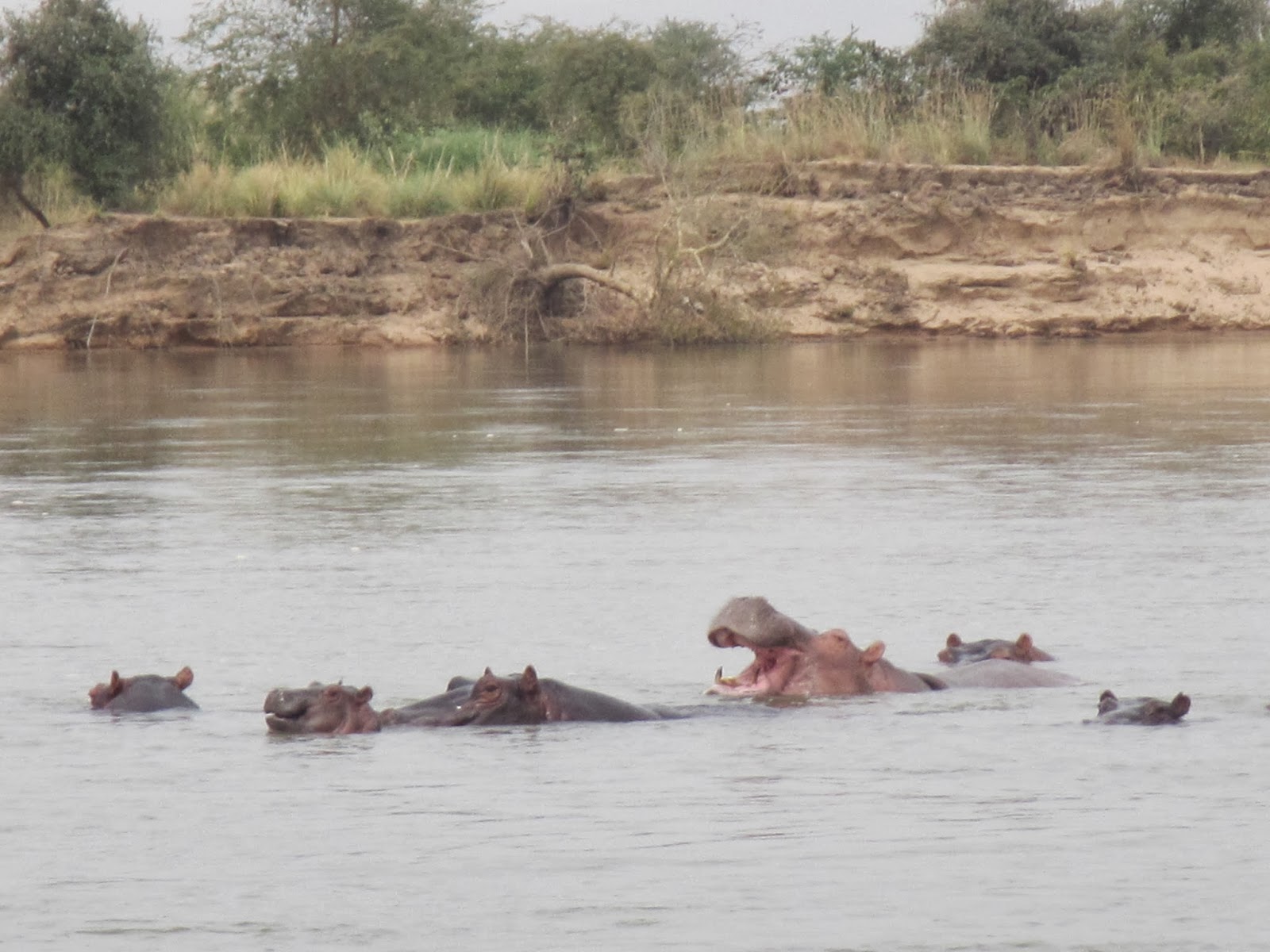
Soon enough we spotted the first massive hippo head, eyes and nostrils just breaking the surface of the water, a Mesozoic monster watching us watch it.  Further downriver we could see the rest of the pod, mostly submerged but betraying their unseen bulk with occasional glimpses of a vast arched back.  We eased to the starboard shore and got out for a closer look.

The striking thing about hippos is their size.  Pictures cannot convey the length of their teeth, the enormity of their yawns, or the sheer underwater mass of these creatures, leftover megafauna from a bygone era.  The five of us stayed on land, watching and taking pictures, marveling over their deeply reverberating grunts and seemingly unhingeable jaws gawping and closing like a real-life version of the children’s game Hungry Hungry Hippo.  Le Maitre, on the other hand, waded promptly into the water towards the pod, calling to them in Fulfulde.


“You know, I read about a guy in Garoua who had trained a hippo and rode it in the river,” Rachel mused, as we watched Le Maitre with trepidation.  “Then it killed someone, so they had to put it down.”  She paused.  “I’m pretty sure that was this guy.”  We nodded thoughtfully, digesting this information.  It might have been better to know this before we put our safety in Le Maitre’s hands.  Then again, now that we were this far into it, it might have been better not to know at all—or at least not until we were safely back in Garoua. 

But we were not fated to watch a hippo mauling, at least not that day; Le Maitre finally, grudgingly responded to our beseeching calls and left the water.  We got back in our boats and headed for Garoua, where I had to deal with the hole in my arm.

The worst part wasn’t cleaning the wound.  The worst part wasn’t the lack of anesthetic.  The worst part wasn’t the first stitch, hooked into my skin with a curved needle like a tool for fixing tapestries, nor the subsequent stitching, obscured by blood so that the nurse had to hook the skin several times before pulling it closed.  No, the worst part was the two-ounce shot of penicillin and lidocaine administered straight into my left glute through a terrifyingly, comically, unnecessarily large syringe.  The shot just kept happening, far beyond the point at which I expected the needle to be withdrawn, my muscle aching the more liquid was forced into it.  I limped back to the Garoua transit house and curled up for a stiff, pained nap.


But I woke up from the nap ready to welcome 2014, and even made it out to go dancing at midnight.  Happy New Year from Cameroon; by definition, it’s gotta start on a better foot than 2013 left on. 


Saturday, December 28, 2013

2013: A Year In Review

As December draws to a close I’ll wrap up my first full calendar year, albeit my 16th month (but who’s counting?), in Cameroon.  It’s cause for reflection; not only am I past the halfway mark of my 27-month service, but once 2014 rolls around, my COS date will be in sight.  It’s a matter of perspective rather than numeric reality—a mere week’s difference—but saying “this year” instead of “next year” makes the end far more tangible, alarming and tantalizing in equal measure.

2013, in some ways, has seemed like the Year That Wasn’t.  As recently as last week I was dating supplemental distribution records 2012.  I have often felt so disconnected from life as I knew it pre-Peace Corps that it’s as though I were living in an alternate reality while all else stood still, waiting for my return.  In the absence of most of what I subconsciously use to mark the passing of months and seasons—federal holidays, changing seasonal weather, new drinks at Starbucks, clothing styles—it’s sometimes jarring to check email, Facebook, or the news in a cyber café and be yanked suddenly to the present.  Friends are engaged, or married, or having kids.  Family members post pictures of themselves brandishing an ice cream at the beach, or romping in autumn leaves, or getting in snowball fights with roommates; it’s surreal to understand that these things are going on concurrently while I slowly melt in merciless heat and watch ragged street children through the cyber café’s doorway.  Politicians change, or do things, or, more problematically this past year, refuse to do things—I missed the government shutdown by several days, and didn’t believe the fellow volunteer who told me about it (“You must have misunderstood, Geoff, it can’t have shut down.  That’s what governments in places like Cameroon do.”)

But whether I’m ready to believe it or not, a whole year has passed since I rang in the last New Year climbing Mount Lagdo (by night, not the wisest decision we’ve made) with three other volunteers from the region.  It was a year of extremes and contradictions; much happened, while at the same time I spent more days with nothing to do than I have, ever.  I learned how to carry on full conversations with minimal mutual language abilities, and learned to speak Fulfuldé.  I decided I loved Mandama.  I decided I hated Mandama.  I experienced some of the most exhilarating highs, and some of the most debilitating lows, of my life.  I’ve made some of the closest friends I’ve had, and watched friends leave, not knowing when, if ever, we’ll meet again.


I spent hours despairing of ever finding work, and hours doing work of all stripes.  I weighed hundreds of babies.  I made gallons of soymilk and pounds of tofu.  I planted dozens of moringa trees, and gave presentations on the nutritional and agricultural benefits so many times I can now do them from memory.  I did door-to-door screenings for malnutrition and malaria.  I learned how to turn off my brain completely when that second or third hour of sitting in the heat at the health center rolled around with no sign of our bibulous chief nurse and, fatally, no book in my bag. Once, upon going to the high school and finding the English teacher hadn’t showed up that day, I improvised an off-the-cuff hour-long class on letter-writing and the difference between the restrictive that and the nonrestrictive which (and for grammar Nazis out there, I felt the irregular restrictive which was only going to confuse, so it was, as usual, ignored).  I raised chickens.  I learned how to farm soy, how to make insecticide soap from natural ingredients, and how most effectively to hiss at goats (it’s the combination of a sibilant ts and the right pitch that really makes ‘em take off running).
Will Saitta and I lead a tofu demonstration as part of a two-day long food security conference.

I learned how to be a good neighbor in this culture, and found that there are many things about my neighbors and about this culture that I just don’t like.  I attended more funerals than I have in the rest of my life to date.  I held newborns.  In my neighbors’ family alone, I watched as two children were born, a child learned to walk, and another child began to talk.  I ate new foods, including viper, boiled grubs (imagine a rubber balloon filled with grits; exactly the horrifying texture I always imagined from watching Pumbaa in The Lion King), and slugs in peanut butter (not quite as vile as it sounds).  I forced Cameroonians to try new foods, like spaghetti sauce and hummus, thus disproving the old axiom about Children In Africa Who Would Love To Eat Those Leftovers.  Children—and adults—in Africa like to eat the limited menu of things they have always eaten and will always eat, and approach new and foreign foods with the antipathy of an American teen being served any of the African dishes I listed above (so take that, Granny!)  I met people I despised—the venal men whose corruption and greed means the system will never function, the wheedling women whose transparent lies enrage me, the children who follow me jeering ethnic slurs—and people whose kindness and willingness to work humbled me.

A stack of sheep legs after the slaughter during the first day of the Feast of the Ram.

I read 54 books, which works out nicely to a book a week.  Among these were several Charles Dickens novels, Moby Dick, and Simon Sebag Montefiore’s 900-page history of Jerusalem.  Like I said, I had a lot of time on my hands.  I watched episodes of 12 different TV shows, despite my resolve not to do so.  I gained 15 pounds.  I ran 232 miles.  I determined that I was definitely, absolutely quitting Peace Corps and blowing this popsicle stand approximately 365 times, and then revised that decision about 350 times—I didn’t have access to a way to leave village the other 15, so here I sit today.  I pooped myself, twice (dysentery’s a hell of a disease).  I saw the desert, watched a troop of baboons in the arid savannah, hiked an equatorial rainforest, and dived into a waterfall on the Gulf of Guinea. 

Eddie Rosenbaum fords a stream on our way to a pygmy encampment in the Congo River Basin.

I could continue in this fashion almost indefinitely, but there’s more to reviewing a year than endlessly declaring what I did.  This is the time to prepare for the next 11 months.  In many ways, they’ll be easier.  I’m established; I know the villagers of Mandama, both friends and foes; I have my work cut out for me.  In other ways they’ll be harder.  I’ll need to devote more and more time and mental energy to preparing what comes next, which will emotionally (and physically, as my Internet needs increase) remove me from my work here, undoubtedly making it harder to be fully present.  I’m habituated to things that once chafed; I no longer yearn for a shower the way I once did, or even a flush toilet.  Still, I’m never totally integrated here.  War correspondent Tim Butcher writes in Blood River, his account of traveling through the Congo, “I longed for convenience so much it hurt.”  I’m not sure if it’s convenience I long for as much as it is accessibility—of information, of communication, of medical supplies, of produce.  I have no doubt their absence will continue to rankle, perhaps even more so the closer I get to attaining them, but I’ve learned to get by without the immediacy of these things.  I’m never sure if I’ve struck the right balance between community integration and personal sanity—I feel alternately irritated and guilty almost always—but I’ve gotten better at it, and I hope I’ll continue to do so.  I’ll be moving several projects into their next phases, and am glad that I know how things work here well enough to start getting long-term goals set into motion. 

Henna'ed hands for the Feast of Ramadan.

Mostly, I hope to keep expanding my horizons.  I’ve seen and experienced an unbelievable amount this past year, despite the days when it feels like all I see are the four walls of my house (now beautified with jazz murals).  I’ve been humbled, and frustrated, and educated, and awestruck, and I hope 2014 brings more of the same.

The view towards Malabo, Equitorial Guinea, from the coast at Limbe.


So here’s to a New Year.  Cheers and a midnight kiss from Cameroon.

Termites with a dry spicy piment rub.

Sunday, December 15, 2013

Both Sides Of The Coin

This blog post is all over the place, but it’s a running list I’ve been keeping of things I’ve come to appreciate here, and thing I’ve come to loathe here.  There’s no single theme; some are contemplative paragraphs, and some are fairly flippant.  Enjoy.

Things That Have Grown On Me Like Fungus On A Toenail

1.     Eating with the hands.  I don’t know when Western civilizations gave this up; the Middle Ages, perhaps, when the knife and the bread trencher became the flatware of choice?  While I understand the public health concerns involved in the direct insertion of grubby fingers into mouth (we did study the oral-fecal route of water-washed diseases at length during training), assuming indoor plumbing, available soap, and the standard of handwashing present in most American homes, I don’t see why there couldn’t be an anti-silverware revolution Stateside.  I find myself voluntarily disposing of a fork when I’m eating alone in my house, even for things like salads that don’t obviously advertise themselves as finger foods.  This either means that I can never go home again, or that I’m on to something here.  After a year of dribbling and splattering on myself like a baby left to his own devices with a jar of Gerber—much to the delight of my neighbors, who never stopped finding this entertaining—I have found that eating with the right hand really is only a question of technique and wrist control.  I defer here to the wisdom of the ancients, in this case Diogenes: “I have been a fool, burdened all these years by the weight of a bowl when a perfectly good vessel lay at the end of my wrist.”


2.     Communal eating and living.  I appreciate the way Northerners all eat out of a single plate.  True, this is hardly an egalitarian system, as men and women are never allowed to eat together; and also true, this too is a vector for disease transmission.  But those important concerns aside, I like the idea of everyone being so fully together.  I am one of those (potentially obnoxious) people who invite themselves to spear a piece of asparagus from someone else’s plate at a restaurant, assuming my dinner companions know they’re free to do the same with anything I’ve ordered; this is that mindset, taken to its complete conclusion.  We don’t share enough in America.  There is value in individualism; but as any socialist writer will tell you, there is equal, if not superior, value in collectivism.  I’ll steer clear of politics here, and stick to everyday examples: I cannot walk down the street in Mandama around noon without someone inviting me to come share what they’re eating.  True, I don’t always want to, because I don’t like what they’re offering or I’ve already eaten.  This is why I sometimes resent the aggressive, compulsive nature of hospitality and sharing that comes with Cameroonian Muslim culture.  But the open spirit of generosity—of never begrudging the opportunity to honor someone else with a gift—is, at its core, beautiful.

This has been one of the most difficult things for me to integrate into, as the American mindset towards property and ownership is so fundamentally different—think a rifle-toting Clint Eastwood growling, “Get off my lawn.”  When people let their goats into my yard, because I have so much long grass and no goats of my own to eat it; or when a boy named Salman asks me every other day for a cup of sugar—this is when I’m trained to think Robert Frost was right; good fences make good neighbors.  I am often a curmudgeon when put in these situations, reacting automatically in proprietary defense: this is my yard and if I want long grass just to look at I’ll grow long grass!  Get your own sugar, kid, and for the record you’re going to rot your teeth out!

But it’s also true that I am resourced beyond the imagination of most Mandamans.  What good does it ultimately do me to hold to what I own with a Scroogian fist?  Learn some humility and share the sugar; that is, after all, the definition of being neighborly.  There is no one in this village who would not give me anything they owned if I but asked; how can I, who have everything, bear the shame of being greedier than people who have nothing?

3.     Pit latrines.  There are times, particularly when I wake up in the middle of the night, when the thought of wrestling my steel door open and stumbling out to the latrine is the last thing I want to do, and in these times I fleetingly wish for a toilet, or even a chamber pot (although I used the latter during my three months of homestay, and let me assure you, that’s a piece of antiquity best left in the fifteenth century).  In general, though, latrines are vastly superior to poorly plumbed toilets in this country, and even some bathroom situations I’ve had at home (here’s looking at you, 7-person suite).  You know how many times I’ve cleaned my latrine?  If you don’t count weeding, zero, because that’s the beauty of it: you can’t clean a hole in the ground.  Unlike a bathroom left in its own fetid squalor, open-air latrines just don’t get that gross.  The rain keeps the slab of cement clean, and I have a lovely moringa tree inside the walls upon which to hang my towel and a roll of toilet paper.  Even those midnight runs are superior: here I am not doomed to contemplate dirty tile or the inevitable clod of roommate hair gently asphyxiating the bathtub drain.  Instead I squat and ruminate, gazing at the coruscating array of constellations flung across the firmament.  Absent light pollution, it’s an impressive sight indeed, and one worth waking up for.  Plus, you can throw anything down latrines.  One time some children showed up at my house playing with a used syringe and needle.  No sharps disposal container?  No problem.  Couldn’t do that with a toilet, now, could you?

Things I Still Detest, And Always Will

1.              Dried fish.  Many sauces that Mandamans eat are flavored with bits of meat, either pieces of beef or entire small fish, bones and all, which have been preserved  (like almost everything in the North) by drying them in the sun.  You might be wondering how it is that people get fish in the arid Sahel; this is a good point.  There is no water here, which is an important prerequisite for piscine propagation.  No, these fish have been shipped in raw, often from Chad, which means they had ample time in the back of a truck to get putrid before being set out in the sun to desiccate.  I am afraid it surpasses my descriptive powers to explain to you just how rank these dried fish smell.  To quote Shakespeare, they are “so rotten that the kites shriek in dismay rather than batten on so foul a carcass”.

Let me try to illustrate this anecdotally: one night this past week, on the way to my neighbor’s for dinner, I walked out of my house and into a miasma of thanatotic stench.  I assumed that this was another round of Scipio’s favorite game, Where’s The Dead Animal Part?, in which she squirrels away cow tails, intestines, and bone bits in and around the house, and I get to follow my nose to my next clean-up job.  Skip is unfortunately good at this game, which is rigged, anyway; whether I find it or not, I lose.  But a thorough search of the porch and yard revealed nothing, so scowling at the dog for good measure, I trooped over to El Hadji Moussa’s compound.  Howa was yelling over the back wall as I walked in, the senior wife, Mairamou, laughing.  I asked what was going on.  Howa wrinkled her nose.  “Salamatou”—the neighbor who lives behind the mosque between my compound and El Hadji Moussa’s—“got out her fish to make sauce.  Now she wants to trade for some of Mairamou’s tasbah sauce because her junior wife doesn’t want to eat the fish.”  This is not an uncommon arrangement; children, who carry out most menial labor here, are sent shuttling between households with small saucepots on their heads in diplomatic exchanges of one housewife’s sesame paste for another’s beef in peanut sauce.  “But Mairamou said no.  You smelled it a few minutes ago when she took it out of the bag, right?  Her junior wife has sense.  None of us want that.”  And so El Hadji’s wives and I join the kites, and shriek in dismay.

2.             Health Care.  Let me make it clear that I am in no way claiming America’s healthcare system is great; anything short of a single-payer system is missing the mark, in my book, but that’s another debate for another day.  What I will patriotically say now (Amuricah, hoo rah) is that at least we’re not as bad as Cameroon.  It’s not much, given where West and Central African countries tend to fall in rankings of this sort of thing, but it’s something.  Small victories, America!  You’ve beat the third world.

I recently took my neighbor Howa and her 18 month-old son, Abdul Karimou, to the regional hospital in Guider, where my friend Will works.  Abdul Karim had been sickly for months; he could not shake a persistent fever and cough and refused to eat, losing weight as a result.  His skin started to look loose, and I was getting more and more worried.  Howa has lost all of her children before they reach two years of age—Abdul Karim’s Dabare name, Touloublaye, translates roughly to “Shall I never give forth life from my womb?”  She took him to the health center in Mandama, where the nurse told her it was malaria; in fact, this is an unlikely diagnosis, but the one given automatically to anyone with a fever.  There are no rapid diagnostic tests in Mandama, and no lab in which to take blood smears and check for plasmodium parasites, so it’s seen as easier to just call it malaria and get on with the next patient.

I suspected tuberculosis, given the productive cough, and thought that at any rate Abdul Karim should be seen by a competent doctor with a laboratory at his disposal.  I had urged Howa several times to take her baby to Guider, but her husband refused to pay, a common attitude here.  He blamed Howa for not taking good enough care of her child, telling her that as he has twelve other children, he could not be bothered to take responsibility for this one.  Thus do polygamy and religion condone criminal male negligence.

So I undertook to bankroll Abdul Karim’s convalescence.  Thus it was that the three of us arrived, squashed onto a single moto, Monday morning.  We met Will, who guided us through the (to my villageoise eyes) bewilderingly complex hospital campus to the intake area.  At 9:00 in the morning, the rows of chairs set up in the sand outside the triage consultation room were already packed with patients.  The nurse, who knew both me and Will, eyed the waiting area nervously.  “You’re going to be here for several hours,” he began, then hesitated and lowered his voice. “Unless, of course, you wanted me to… speed things up?”

Normally I detest the culture of corruption, nepotism, and mutual backscratching that pervades every aspect of Cameroonian life, but as Will and I exchanged glances, I could see the same thought in his eyes: The line really was awful long.  “Play the white card?” I murmured, and he nodded discreetly to the nurse.  Howa and Abdul Karim were whisked back to the intake office, where his symptoms were recorded and we were sent to another building to wait to be seen by the director of the hospital. 

Here, not even my presence could get us special treatment, so I got my book out of my bag and we settled into our plastic chairs for a five-hour wait.  When we finally did see the doctor, Howa—trained to be deferential to men and particularly authority figures—was too cowed to even speak, so I asked if I could be part of the consultation, and explained Abdul Karim’s health problems.

The doctor began writing a two-page list, a battery of tests he wanted run—everything from a fecal sample to a blood smear to radiology—and an even longer list of drugs to buy.  I frowned, as seven medications taken simultaneously seemed above and beyond what could possibly be needed.  Howa, frightened and submissive, was ready to take the paper and bolt, but I stopped her, asking the doctor to explain to us both what he was prescribing and why. 

He sighed, impatient, and flew through the list with exaggerated rapidity.  “This is in case it’s tuberculosis.  This is for bronchitis.  This is an antibiotic.  These two are cough syrups--” (with, I might add, identical active ingredients; redundancy on top of excess) “—and this is an anti-malarial.  This is for the fever.  If none of those treat it and the tests aren’t conclusive, come back and see me.”

I asked if we shouldn’t wait to buy medications until we knew the results of the tests—if TB could be ruled out, for example, why begin a six-month regimen of antibiotics?  Why automatically treat malaria when rapid diagnostic tests are provided free by the Cameroonian government for children under 5?  He waved this away, however: he had too many patients already, and we had been seen.  We had our prescription; the consultation was over.

In typical Cameroonian fashion, we were unable to find any of the hospital staff that we needed to run the tests that afternoon; they had all gone home early, or were somewhere else, or had locked up and vanished.  I hesitated at the pharmacy, unwilling to subject Abdul Karim to a shotgun blast of medication (throw the whole pot of spaghetti at the wall and see what sticks!).  I am not a doctor, as I constantly have to tell people, and yet here I was, having to make an amateur diagnosis. 

I ended up buying the most general antibiotic, one of the cough syrups, and Paracetamol for the fever.  Howa was eager to return to Mandama, but promised to come back to Guider the next morning for the radiology and malaria test, which would guide any further pharmaceutical purchases. 

The next morning she never appeared.  I went back to Mandama that afternoon to find her and Abdul Karim in their compound.  “What happened?” I cried.  “Where were you two?”

She shook her head.  “You know how my husband is.  El Hadji Moussa would not give us permission to leave a second day in a row and go back to Garoua.  He said we saw the doctor and have all we need.  He will not accept that we go back for more tests.”


So there the matter came to an end.  It has been almost a week, and Abdul Karim’s fever is down.  He is still coughing, but it is a much drier cough; the phlegm and mucus have stopped, which is a good sign.  I can only hope that I made the right decisions.

Howa watches with trepidation as Abdul Karim wields baby's first hoe.

Friday, December 6, 2013

Same Shit, Different Toilet

I often focus in these entries on differences between my expectations and those of the Cameroonians I work with.  This is primarily because it is often these cultural differences, these misunderstandings and assumptions on each side, that lead to the most revealing, or frustrating, or comedic exchanges.  It’s also interesting for me to realize how much of my behavior is dictated by my country and culture, rather than by some objective human standard of normalcy.

At the end of the day, though, people are people, and I’ve been equally interested to note what instinctive behaviors stay the same across the board.

I present, Things That I’m Finding To Be Universal:

1.              That doofy face people make at babies.  One of my favorite things to do when I lived in New York and took the subway was to watch people’s faces when someone pushed a stroller onto the car.  The most hardened of riders, whose studiedly expressionless masks seemed likely to withstand anything from an earthquake to a zombie apocalypse, would suddenly soften.  Their faces would open dramatically, eyebrows shooting towards the hairline, mouths gawping into exaggerated smiles, as though trying to show a dentist all 28 teeth at once.  People here do that, too.  Why is this an instinctive response to seeing small pre-formed humans?  You tell me.


D'awwwww!

2.              The smell of a preschool.  I’ve only been into the école maternelle here a few times; other than handwashing, the toddlers are a little young for the health and nutrition education classes I normally give.  Each time, however, I’ve been struck by the smell, and how evocative it is of every kindergarten class I’ve ever walked into.  I can’t put my finger on exactly what it is—crayons? Disinfectant? Child-sweat?  It is also worth noting that the preschool is run by Polish nuns; maybe it’s the corresponding increase in resources that makes it smell a certain way, because the vastly underfunded and understaffed primary school sure smells a lot worse.

Graduation at the ecole maternelle last spring

3.              Shouting at people who don’t speak your language in the misguided belief that sheer volume will overcome linguistic barriers.  This surprised me the most, as I assumed this was a dumb American thing, but it turns out it’s not only the Texans.  For several months I thought the president of one of my women’s groups, Djanabou, was slightly deaf, as she always roars at me in Fulfuldé or Dabaré as though trying to call cattle home from several fields away.  Then one day I went to her compound to ask about scheduling and watched her talk to her son in a totally normal tone at regulated volume, and realized she reserves her outside voice for me.

4.              Complaining about The Kids These Days.  For a while I didn’t want to say this because I was afraid of sounding elitist, but let’s call a spade a spade: most of the conversations I have around here are repetitive at best, and inane at worst.  Without any access to media, people can’t complain about Congress’ most recent buffoonery or gossip about First Lady Chantal Biya’s new and ever more clownish hairstyle.  Instead, they stick to the following subjects: the weather; the crops; some wild and totally baseless “fact” that, lacking Internet or a library, is stupidly difficult to disprove (“There are no black people in America” is one I run into all the time. Obama “doesn’t count”, since, I’m told, he’s not an American citizen); and the kids these days.  I have had ample time to consider the specifics of this last category of complaint, as I am subject to it practically every time I sit with older men waiting for a meeting to start.  This waiting period can take hours, so I’ve gotten an earful.  The content of the complaints is the same as what you’d hear in any barbershop in America; it’s the context that differs.  According to my sources, the Kids These Days:
a.     Are weaker than they used to be.  Why, these days, some young buck walks five miles out to his field in the morning, works in the sun, and he’s tired by noon! Tired! Can you imagine? In MY day… (I did ask my interlocutor if, in his day, he walked uphill both ways to get to his field and back.  He looked confused and ignored the question; I guess some things just don’t translate.)
b.     Are wastrels.  You take an old man to the market, he’ll buy a used shirt from the Goodwill cast-off pile for 200 CFA (40 cents USD) and be happy.  These kids, though, they want to buy their own fabric and have their own clothes made like they think every day’s a fete day!  And where is this money coming from?  They’ll all be driven to a life of crime, you mark my words! (In my experience youth wear traditional clothes far less than old men, actually, and are more likely to be sporting an Ann Arbor Michigan 5K for Leukemia shirt than a boubou, but there’s no gainsaying an elder with a grudge once he’s on a roll.)
c.      Are sybaritically self-indulgent. “Avant” (“before”, the vague descriptor of the Good Old Days), women made sauces with tree sap and leaves and peanut butter.  It was simple, it was good, and it was wholesome.  Now, they all want their Maggi cubes before they’ll even think about cooking! And at what cost? (Answer: very little cost, and much less work than boiling tree sap to get an extract to flavor food.  For my American audience, Maggi Arome, literally translated as Maggi Brand Flavor, is pure MSG.  It’s sold in liquid or powdered form, and used widely by all Cameroonians to flavor everything.  It also costs less than five cents a cube, so it’s hardly a drain on the family finances.)
d.     Get AIDS more easily.  It’s like they do it on purpose! (This complaint just confused me.  I tried to point out that the AIDS epidemic didn’t hit crisis levels until the 80’s, and that as more people are overcoming the stigma to get tested, it may just be that more young people know their HIV status than they did thirty years ago, but again, I got nowhere.)
e.     Are impatient.  You tell some kid to wait under a tree for you, he doesn’t even stick around a full hour before taking off!  (This is so very African, I have no commentary to make.  Imagine telling an American of any age to twiddle their thumbs because you’re two hours late for a rendez-vous.  I’m pretty sure marriages have ended over less.)

So there you have it.  The world over, we find babies to be cute, don’t know how to deal with foreigners, and think this generation’s the worst one ever.  Goal 2 achieved.